.svg)

A single optional form field was costing Expedia $12 million a year.
The field said “Business name.” It sat just above the billing address on a checkout page. Customers saw it, assumed it meant their credit card company, typed in Bank of America or Chase, then entered the address printed on the back of their card.
The transaction failed. Address verification error. No explanation that made sense to the customer.
They did nothing “wrong.” The company did.
Delete the field, and the business got $1 million a month back overnight. And $12 million annually.
That story came up on the newest episode of The Frictionless Experience, when Joe Megibow explained how his team uncovered it years ago at Tealeaf. And it perfectly captures a truth we keep relearning about friction.
“One thing I've learned is if you put a field in front of customers, they're going to try to fill it out.” — Joe Megibow
The field was optional. It even said optional. It still caused massive, invisible damage.
During the episode, we explored more about why that happens, why friction is rarely where teams think it is, and why “frictionless” doesn’t mean removing every obstacle in sight.
Why Friction Is Rarely Where You’re Looking
Most organizations hunt for friction by staring at dashboards: conversion rates, page load times, abandonment percentages. Those metrics matter, but they rarely tell you why customers struggle.
Joe’s early work at Tealeaf helped change that perspective. Instead of relying on server logs and aggregate data, his team focused on what customers actually saw.
As Joe put it:
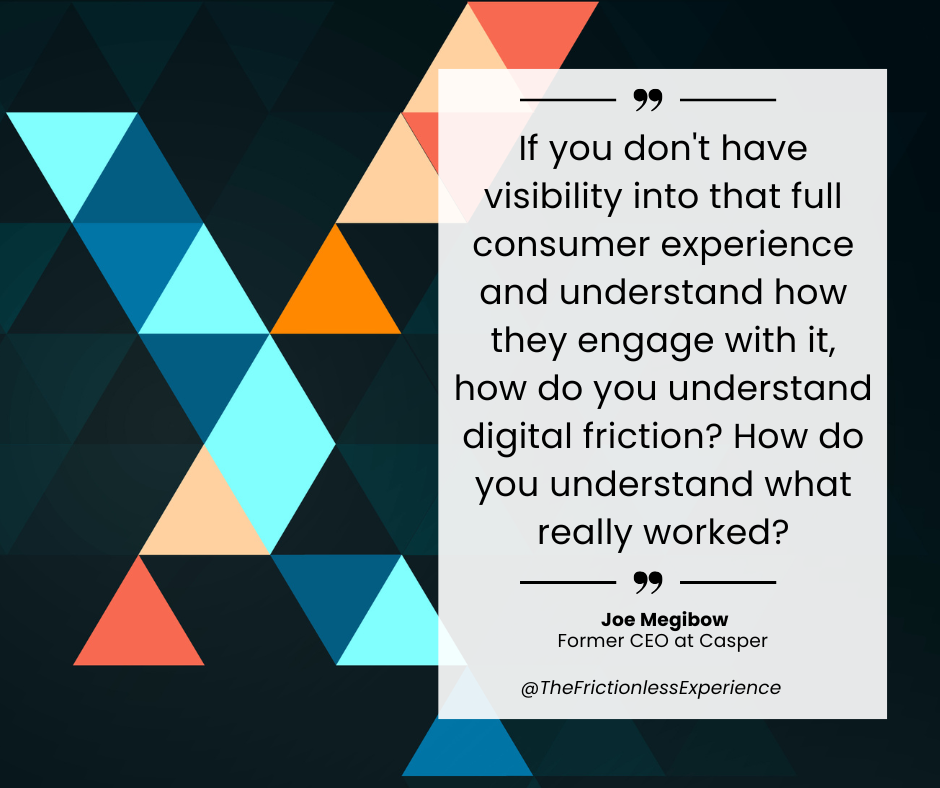
The checkout-field example wasn’t a bug. Nothing was broken. The form worked exactly as designed. But the mental model in the customer’s head didn’t align with the team's assumptions about it.
That mismatch is where friction lives.
And it’s why teams that assume they already know how customers behave miss the most expensive problems.
When Metrics Become the Friction
The most expensive friction rarely comes from bad intent. It comes from teams doing exactly what they were told to do.
That same dynamic showed up in another story we discussed on The Frictionless Experience, when Kacey Sharrett, Vice President of Direct to Consumer at GoPro, described a retailer obsessed with improving order fill rate. The KPI was clear: hit 90–95%, and success would be reported up the chain.
On paper, it worked. The metric turned green.
But the behavior it created was absurd. To hit the number, store teams were driving to a competitor, buying their own product off the shelf, and then fulfilling the order.
The fill rate was met. The business was not.
As my co-host Nick Paladino wrote here, this is what happens “when the metric becomes the mission.” Teams optimize what’s measured, even when it actively works against margin, efficiency, and customer experience.
The optional form field followed the same pattern. It existed to satisfy an internal assumption about data completeness, not a customer need. The KPI existed to satisfy a dashboard, not a business outcome. In both cases, nothing appeared to be broken internally. And in both cases, customers quietly paid the price.
Invisible friction thrives in systems where success is defined too narrowly—and where no one is watching how customers actually behave in response.
And just like the $12 million form field, the real cost wasn’t visible until someone traced behavior all the way to revenue.
The Economics of Friction (and Why Small Things Matter)
At Tealeaf, finding friction wasn’t academic. It was how the company proved its value.
“The only way we made money selling this software solution was to demonstrate that we improve conversion, improve revenue on people's sites.” — Joe Megibow
That meant tracing friction directly to dollars. Not hypotheticals. Not UX scores. Real revenue.
The optional form field wasn’t an isolated case. Joe described how his team would mine error messages across sessions:
“We just started mining every instance of that class, that style showing up on the page. Show me every time red text appeared for consumers.” — Joe Megibow
Patterns emerged quickly:
- Forms that customers had to submit three or four times.
- Validation rules that made sense to engineers but not humans.
- Fields that were technically optional but psychologically mandatory.
None of these showed up as “critical bugs.” All of them quietly eroded trust and conversion. And when friction deep in the funnel emerges, its economic impact compounds quickly.
The most successful companies have realized that the secret to capturing more conversions and revenue lies in delivering a frictionless digital experience.
Each revenue-robbing friction point presents an opportunity to improve the digital experience and business outcomes. But how do you decide where to start?
How to Actually Quantify Friction (and Decide What to Fix First)
Based on patterns we see again and again, here are a few practical recommendations for turning hidden friction into something measurable and actionable:
- Start with revenue loss, not UX scores.
- Look for repeated struggle, not single failures.
- Tie friction to real customer paths.
- Prioritize fixes by financial impact.
Blue Triangle is the only platform that starts and ends with business outcomes, so you can seamlessly and effectively:
- Quantify the conversions and revenue loss resulting from digital friction.
- Then, identify where to deploy resources based on impact to resolve costly friction.
- And lastly, validate the outcomes achieved from your optimizations with revenue attribution.
Speed Is Not the Same Thing as Friction Reduction
One of the most persistent myths in digital experience is that faster automatically means better.
Joe shared a counterintuitive lesson from his time at Expedia:
“The bigger content, slower page outperformed the faster page with less content.” — Joe Megibow
Why? Because friction is not measured in milliseconds. It’s measured against expectations.
Joe explained it this way:
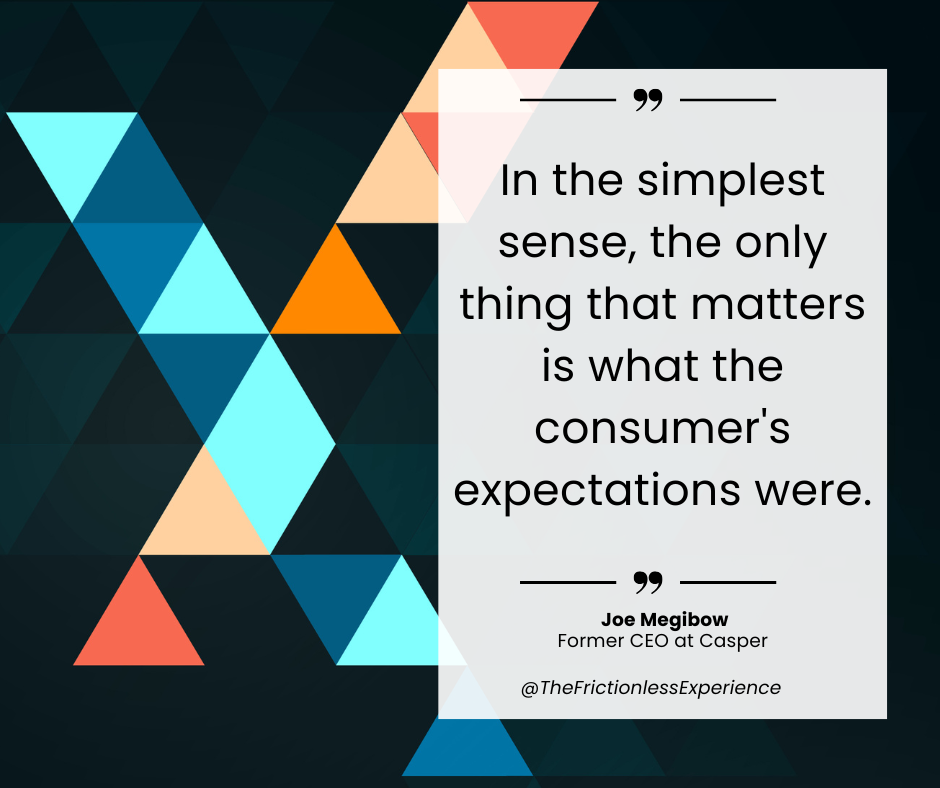
Waiting 15 minutes at the DMV feels amazing. Waiting 15 minutes at Starbucks feels broken.
Same time. Totally different experience.
When teams optimize purely for speed budgets, they often remove the very information customers need to feel confident. The result is technically fast experiences that feel slow, confusing, or incomplete.
That’s not frictionless. That’s brittle.
When Consistency Becomes a Trap
Platforms like Shopify have mastered consistency. Familiar checkout flows reduce cognitive load and help customers move quickly.
But consistency is not the same thing as correctness.
Joe cautioned against confusing familiarity with optimal experience:
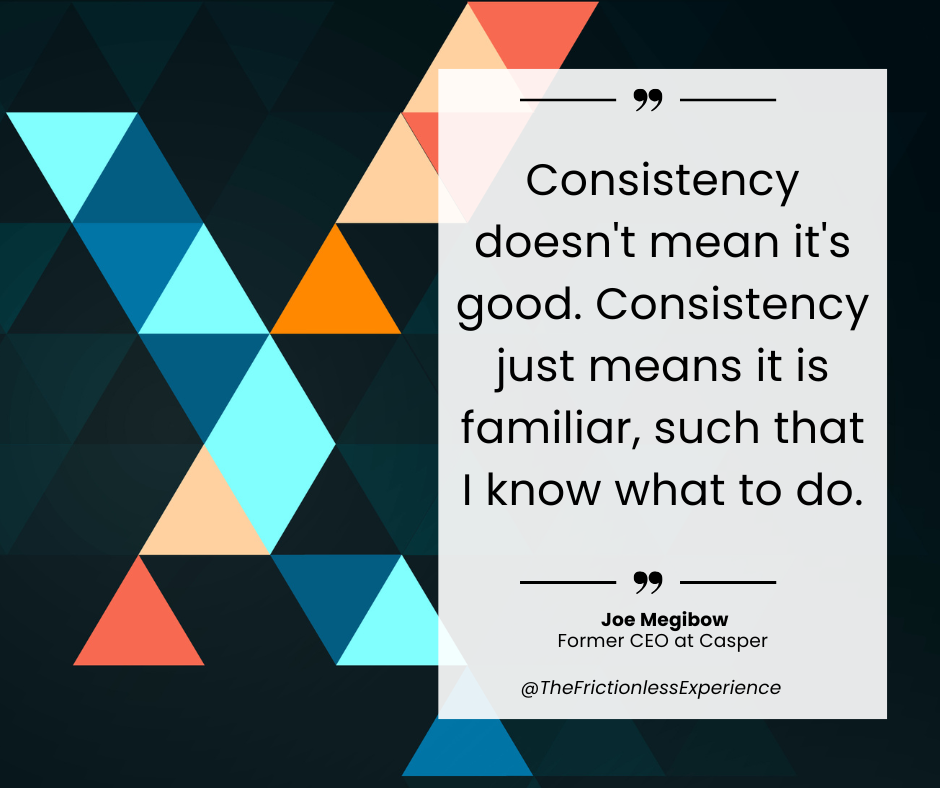
Standardization solves for the average customer. It can quietly introduce friction for everyone else.
Joe gave an example from high-consideration purchases:
“Once you get that deep in checkout, you literally have to now log out of Shopify to see those options and get back in.” — Joe Megibow
In trying to optimize the most common path, companies often make less common but highly valuable paths dramatically harder.
That tradeoff is rarely visible unless you actively watch how different customers try to complete the same task.
Omnichannel Friction Is Organizational, Not Technical
Some of the most damaging friction has nothing to do with screens at all.
At American Eagle, Joe inherited the “omnichannel” label before anyone had defined what it actually meant.
His conclusion was simple:
“It was really eliminating the friction across channels so that the consumer's needs are met regardless of their channel choices.” — Joe Megibow
What he found instead was a maze of internal incentives:
- Stores penalized when customers ordered online.
- Different shipping rules depending on channel.
- Separate inventory planning for the same customer.
From the customer’s perspective, it was one brand. Internally, it was multiple competing businesses.
The fix wasn’t a UX tweak. It required changing how success was measured.
“You've got to widen the aperture and look at this holistically from the consumer point of view.” — Joe Megibow
Sometimes friction exists because removing it would force uncomfortable organizational change.
When Adding Friction Actually Improves Conversion
In low-frequency, high-risk purchases—mattresses, sleep products, travel—immediate conversion is often the wrong goal.
Joe was blunt about this reality:
“These are considered purchases. Introducing friction to the cycle is actually reducing friction on the entire purchase journey.” — Joe Megibow
Encouraging a customer not to buy yet—by visiting a store, talking to a human, or taking time to evaluate—can dramatically improve long-term outcomes.
Friction that aligns with customer decision-making isn’t friction at all. It’s guidance.
The Most Dangerous Myth: The Contact Center as Failure
The belief Joe disagrees with most?
“Most people believe the contact center… only exists because of failure of digital friction.” — Joe Megibow
At Expedia, Joe discovered something that shocked him:
“Like 30% of our sales were happening through the contact center.” — Joe Megibow
And those weren’t weak sales:
- Conversion rates of 30–40%
- Higher average order values
- More complex, higher-risk purchases
Why?
“It was literally just, ‘This hotel is great. You're going to love it.’ You could hear them take a breath and be like, thank you.” — Joe Megibow
Human reassurance was the feature.
At American Eagle, that insight led to over $100 million in contact-center-driven sales.
The lesson is simple: sometimes the lowest-friction path is to deliberately introduce a human.
Friction Is a Signal, Not an Enemy
The $12 million form field story endures because it’s tempting to believe friction is obvious, but it isn’t. Friction hides in assumptions. In internal metrics. In incentives customers never agreed to.
The teams that win are the ones willing to stop guessing and start watching.
Or as Joe put it early in his career shift:
“I had to find a way to let my customers tell me.” — Joe Megibow
That still works. And it’s still where the money is.
Key Takeaways: What This Means for Your Digital Experience
1. Most expensive friction is invisible to analytics: The $12M form field showed no
technical errors but created massive customer confusion through mismatched
expectations.
2. Metrics can create the friction they measure: When teams optimize for the wrong
KPIs, they often introduce new problems while appearing to succeed.
3. Speed ≠ frictionless: Faster pages can increase friction if they remove information
customers need to feel confident making a decision.
4. Contact centers aren't failure points: High-value, complex purchases often convert
better through human interaction, not self-service optimization.
5. Friction signals misalignment: Customer struggle often reveals organizational
problems, not just UX issues.
6. Adding friction can improve outcomes: For considered purchases, slowing the process
to match customer decision-making reduces overall friction.
Frequently Asked Questions
Q: Can small or optional elements really cost money?
A: Yes. Even a single optional form field can silently erode millions in revenue. Blue Triangle shows exactly where customers get stuck, how much revenue it’s costing, and what to fix first—so you never miss hidden revenue robbers.
Q: Can metrics or KPIs create friction?
A: Absolutely. Teams often optimize internal dashboards or assumptions that inadvertently introduce friction. Blue Triangle links experience data to real revenue, helping you focus limited resources on fixes that deliver the biggest ROI.
Q: How can companies uncover friction effectively?
A: By observing real customer behavior, not just aggregate metrics. Blue Triangle identifies your highest-converting paths, pinpoints where users struggle, and quantifies recaptured revenue—turning friction into actionable insights.
Q: Is faster or more consistent always better for customers?
A: No. Speed and standardization help some users but can frustrate others. Blue Triangle exposes the specific causes of friction, including slowdowns from third-party content or page performance, so improvements actually align with customer experience and business results.
Q: Can friction ever be beneficial?
A: Yes. For complex or high-risk purchases, strategic guidance or human interaction can improve long-term conversion. Blue Triangle lets you see the full journey, so you can optimize where friction adds value instead of guessing.