.svg)

Most AI strategies begin with the wrong question. Companies ask: which tool should we buy? Which team should we pilot it with? How do we show the board we're moving fast enough?
Sriram Krishnasamy — the man who engineered $4 billion in structural cost reduction at FedEx — thinks that's exactly backwards. And in an era where AI has made it easier than ever to quantify the cost of friction, optimize your workflows, and prove ROI to the C-suite, the gap between companies who get this right and companies who don't is about to get a lot wider.
The right first question, he says on The Frictionless Experience, isn't about technology at all: do you actually understand how work gets done inside your company?
Because if you don't — and he argues most companies don't — deploying AI won't fix your friction. It will turbocharge it.
The Man Who Left 2,500 People to Build a Team of Five
To understand why Sriram thinks the way he does, you have to understand the bet he made.
At the height of his career at FedEx, he was running an organization of 2,500 people. Then he walked away from it — voluntarily — to build a five-person internal startup. Not because he was pushed out. Because he saw something hiding in plain sight that almost no one else had noticed.
FedEx moves seventeen million packages a day. Every one of those shipments generates data: where it came from, where it's going, what industry it belongs to, how long it took, where it got stuck. Sriram saw that asset for what it was — not a logistics byproduct, but what he called "a microcosm of global trade" — and he believed you could build something extraordinary from it, if you had the discipline to ask the right questions first.
That discipline is the thread running through everything he shared on our latest episode of The Frictionless Experience. And it turns out the same discipline that helped FedEx unlock billions in value is the exact thing most AI strategies are skipping entirely.
Lesson One: The Workflow Comes Before the Technology
Sriram opens with a question he says he puts to CEOs, and it's deceptively simple:
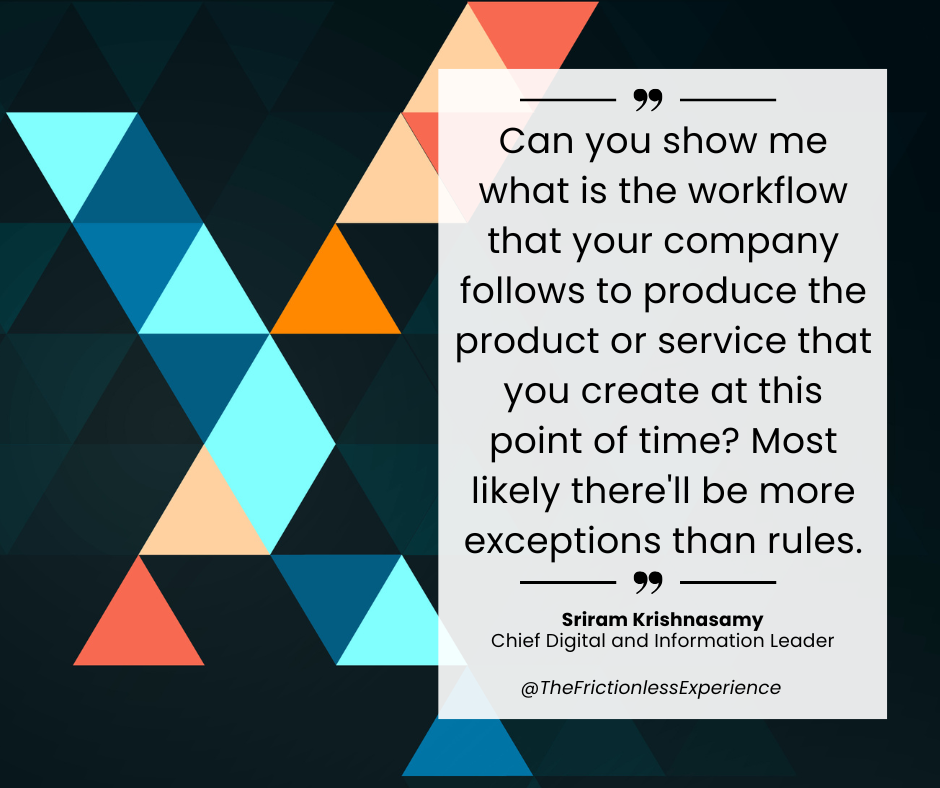
Think about that for a second. Most organizations — especially ones that have grown through acquisitions, that have been adding software for thirty years, that have layers of processes no one fully owns anymore — cannot actually answer that question cleanly. And yet those same organizations are now deploying AI on top of that uncharted complexity.
Here's Sriram's point: AI doesn't fix ambiguity. It amplifies it.
"The more you think workflows, the more you're going to be able to use AI. That's what it does, right? It's the first technology that's capable of understanding context. And workflow is a great framework for defining context."
This is the first leg of what he calls his "three-legged stool": business architecture, meaning a clear definition of how work actually flows — inside your company, and inside the lives of your customers. Not what the org chart says. Not what the process deck says. What actually happens, day to day, in the hands of real people.
The second leg is experience engineering. Once you know the workflow, you have to ask: what does the day-in-the-life of the person using this tool actually look like? Not theoretically. Practically.
"A completely differentiated tool is going to create adoption barriers... the perfect model that's adopted by five percent of an organization versus a model that mimics how the day in the life of a person in your customer or in your workforce looks like — it has much bigger chance of success."
The third leg is technology. It comes last. Always.
Most companies build the stool in exactly the wrong order.
Lesson Two: The Vaccines, and Why You Don't Need a Data Lake to Create Value
Early in his work at FedEx DataWorks, Sriram's team was building something called "package fingerprint" — a predictive model designed to identify at-risk shipments before they failed, not after.
The old model was reactive. A package would miss its connection in Oakland at 5:30pm with a 6:30pm delivery commitment in Los Angeles, and only then would someone flag it as a problem. Dead on arrival. Sriram wanted to see failure coming hours earlier, when something could still be done.
Then COVID vaccines arrived.
Overnight, FedEx was handling shipments where the margin for error wasn't measured in customer satisfaction scores — it was measured in human lives. Vaccines had to move at unprecedented scale with near-perfect service levels. Leave a shipment sitting in a facility for a day, and the next day it's gone. You couldn't white-glove every package manually. There weren't enough people, and there wasn't enough time.
His team pivoted package fingerprint to the problem. The result, as FedEx announced publicly, was a 99.8% service level on vaccine distribution nationwide.
But here's the thing he wants you to take away from that story — it's not the 99.8%. It's the philosophy that made it possible:
"I was very deliberate in using the word insights and not data. Creating value from the insights, not data. The more important questions to ask is what do you need the data for? And are you able to articulate it with specificity? Not generic statements like we want to do analysis and run complex deep learning models on top of it. What problem are you trying to solve?"
FedEx had seventeen million daily shipments worth of data. The temptation to capture all of it, model all of it, build a complete digital twin before doing anything useful — that temptation is real, and it's exactly how most enterprise data strategies stall out.
Sriram drew the line early and clearly:
"For every large company that has the ambition of building out a digital twin of their network, the Pareto rule applies. Twenty percent of the data creates eighty percent of the value. Being very conscious in saying what's enough to create the first insight that you can quickly put out in the field, test, measure the value, tweak, correct, and grow over a period of time."
Find the 20%. Prove value. Then grow. The companies drowning in data strategy rarely out-execute the ones who just went and solved a real problem.
Lesson Three: AI Ready Is Not the Same as AI Native
Sriram noticed something about quarterly earnings calls. If you plot how often the word "AI" appeared in results calls before ChatGPT launched versus after, the curve goes nearly vertical. Every CEO is saying it now. Every board is asking about it. Every transformation deck has it in the title.
His reaction to that isn't cynicism. It's a warning:
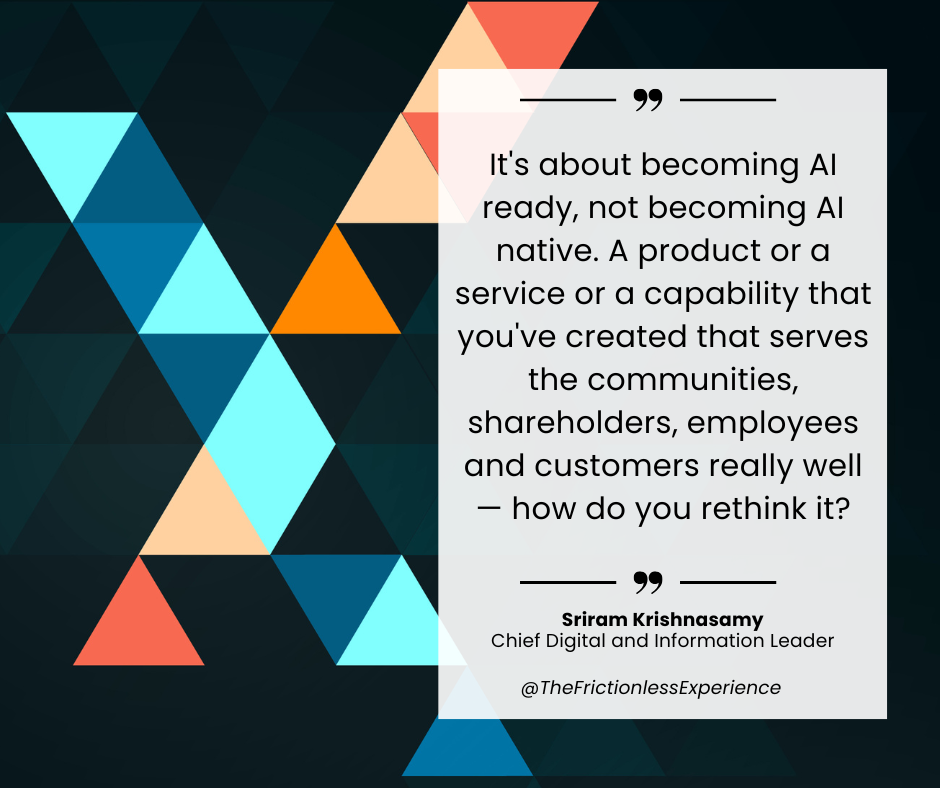
There's a real danger in watching every competitor announce an AI strategy and deciding you need to rebuild your company around AI to keep up. Your company has an identity. It has something that made people want to pay you in the first place. Chasing AI nativeness can hollow that out faster than any competitor.
His framework for avoiding that trap is grounded in something almost old-fashioned: start with your commitments.
"Reinforce what those commitments are, understand how you plan to deliver those commitments and become much more cognitively clear in what you're trying to achieve, who you are and how you're trying to achieve. Add a layer of empathy, which is who am I asking to change? And what are they used to doing for 20 years or 25 years? And then architect the available technology around it."
Know your identity. Know who you're asking to change. Then — and only then — bring the technology to bear.
The alternative has a name, and he gave it to us plainly:
"The most important thing for a company's ability to use AI, in my humble opinion, is how cognitive you are as an enterprise. Because the danger of AI is if you just go train twenty thousand people and put copilots on their desk, it is going to enhance cognitive dissonance that exists already, much faster than humans did."
Nick and I laughed at that one — but it's uncomfortable laughter, because we've watched it happen. Every slide deck in our orbit now looks completely different from every other one, different fonts, different styles, because everyone's generating their own in Claude without any shared framework underneath it. It's not transformation. It's amplified chaos at scale.
All of which brings it back to something simpler — the principle underneath all three lessons.
Context and Empathy Beat a Pretty UI Every Time
I close every episode with the same question: what's one widely held belief about frictionless digital experiences that you fundamentally disagree with?
Sriram didn't hesitate.
"People think that frictionless experience is about the beauty of the UI/UX. For me, frictionless experience is first about context and empathy. The app that's not the prettiest on my phone is the one that I use the most. It's the Amazon app. Because it nails my workflow. Am I in Dallas? Am I in Memphis? Am I in New York? It connects to my phone, knows my location, tells me, hey, you're making a mistake. Do you want this to go to Memphis? It understands my workflow as a human being to a fault."
That's the whole thing, right there. Not pixels. Not the skin. Context and empathy — knowing who your user is, where they are, what they're trying to accomplish, and meeting them there.
The companies that figure this out will find AI to be the most powerful tool they've ever had. It's the first technology, as Sriram puts it, that can not just help you execute decisions faster — it can help you ask better questions. That's a remarkable shift. But only if the foundation is solid.
If it isn't, you're not buying a solution. You're buying a faster way to fail.
This is one of the best conversations we've had on The Frictionless Experience — and we're only scratching the surface here. Sriram goes deeper on the three-legged stool, the FedEx DRIVE transformation, and what AI is actually going to do to human cognition in the full episode. Listen here.