.svg)
On The Frictionless Experience, Nick Paladino and I have spent a lot of time thinking about why technology rollouts fail. Not the technical failures, but the human ones.
The software bought on a Monday and abandoned by Friday. The sales tool nobody uses. The platform that looked like a game-changer in the demo and a paperweight six months later.
So when we got to sit down with Dean Curtis, who was literally in the room as Apple cracked the enterprise market, on this episode of The Frictionless Experience, I knew we were going to get somewhere real.
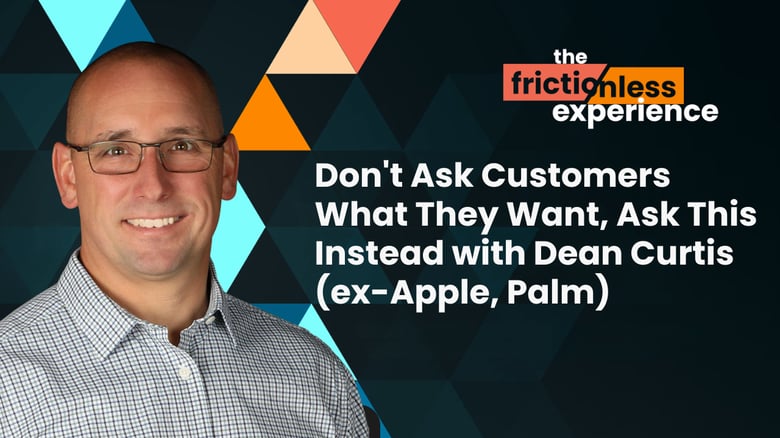
Dean's path ran through Oracle, IntelliSync, Palm, and then eight years at Apple driving iPhone adoption into Fortune 500 companies. He now leads Ingage, a platform built to help home improvement companies sell more effectively. The thread running through all of it? Understanding why people actually adopt technology and why they don't.
Customers Can't Design What Doesn't Exist Yet
Before Dean even joined Apple, he had a telling moment in his interview. Sitting across from the VP of iPhone — in a suit and tie, completely out of place at Apple HQ — he asked whether the lack of a physical keyboard would kill their chances in enterprise. The VP paused and said, "I think we're gonna be okay."
The keyboard story is about more than a product decision. It's about a truth most companies forget.
"Your customers don't know what they want always," Dean told us. "No one was asking to get rid of the keyboard. But in reality, once they had it in their hands, they said, 'Hey, this is what I wanted.'"
Apple didn't ask users what they wanted. They asked what problem needed solving. The insight wasn't "make a better keyboard" — it was: why should a keyboard take up 50% of the device 100% of the time when you're not using it 95% of the time?
Dean trains his own team at Ingage on this exact principle.
"We train on this in our customer experience and our customer success team because customers will come to us all the time with feature requests. And you're like, I don't actually want them to design the features. There's a reason they're not designing software. They're doing what they do. Tell me what problem they're trying to solve."
The same thinking showed up in how Apple approached enterprise security. IT administrators kept asking for device encryption — and describing exactly how BlackBerry did it. Apple built a hardware-based encryption chip that handled it in real time, invisibly, with no user friction. Nobody asked for that. But everybody wanted it once they had it.
"I think if we can all come to the table not with solutions but with great problem definitions, let the experts solve the problems, I think a lot of things might accelerate in their development."
The Three Pillars Most Rollouts Are Missing
Dean's diagnosis of why software deployments fail is consistent: companies don't think hard enough about the start of the process.
"We find a lot of people don't put any thought into — or don't put enough thought into — the beginning of the technology deployment."
After working with companies of all sizes, he's identified three stakeholder roles that have to be present: IT and technical ownership, brand and marketing ownership, and — most critically — someone responsible for training, enablement, and readiness. That last one gets skipped most often and kills rollouts.
"So many times we buy a piece of software, there's someone in the organization who thinks it's going to absolutely change the game for us. And we say, 'Hey, this software is now available. Everybody go use it.' And people are like, well, I don't understand how it fits in my workflow. If I'm all of a sudden gonna put this software in place in my sales process, I might not make the same money."
The most extreme version of this came from Dean's Palm days. Palm did a proof-of-concept with the California Highway Patrol — Palm Pilots with an app that let officers scan a barcode on a license for a quick lookup. Every single device came back broken after three days. The officers had run over them with their patrol cars. On purpose. Because nobody ever asked if this was a problem they needed solved.
"They were just revolting against the technology right from the beginning."
It's rarely a technology problem. It's a people problem — and it starts with not involving the right people from day one.
Trust Is the Real Sale — And It Shows Up on the Bottom Line
My co-host Nick shared a story during our conversation that cuts to the heart of what Ingage actually does for its customers.
Nick had a pen-and-paper plumber come to his house — napkin math, completely old school. He said yes on the spot because his builder, someone he deeply trusted, had referred the guy. The technology was irrelevant; trust did the work. But another time, he hired a plumber from a large franchise — fully digital, organized presentation, every step of the process laid out clearly. Same level of confidence, built an entirely different way.
"Both can do the job," Dean said. "The question is which one, when you're signing on that paper, do you have more confidence is actually going to do it the right way the first time so that you can have the problem solved that you have."
Dean calls this a "very difficult needle to thread." As he put it: "Like any sales member wants to portray or build belief in the person they're selling to. It doesn't matter what you're selling. Now, when you're talking about high-ticket items, which is the world we live in, it does raise the game."
That confidence turns out to be a measurable business outcome, not just a feeling. Dean's team tracks close rate, average deal size, time per appointment, and lead conversion. And in today's market, he's clear about what matters most: "The name of the game is lead conversion."
When a sales rep walks into a home with a well-designed, interactive presentation, those numbers move. "If you give it time, you will build more confidence in the person you're selling to. And when you build more confidence, you will close more deals for higher volumes, for higher rates."
A four-point lift in close rate — not unusual for Ingage customers — translates to $400,000 to $4 million in additional revenue depending on company size. For a $10 million home improvement company, moving the needle by 10% means another million dollars. That's not a software story. That's a business transformation story.
Getting Resistant Salespeople to Actually Adopt
If you've ever tried to roll out new technology to a sales team already hitting their numbers, you know how this goes. Dean's answer is straightforward: tie it to their money.
"The easiest answer on that is you tie it to their money and you say, 'Listen, I understand that you may have the dip at first, but we've seen — we have data from hundreds and thousands of customers — that if you give it time, you will build more confidence in the person you're selling to.'"
The productivity dip is real. Any new tool has a learning curve. But the goal isn't to pretend the dip doesn't exist — it's to shorten it. Dean compares it directly to onboarding a new hire: "You're going train them, you're going to enable them. You might expect that productivity in that role drops for a little bit, but eventually if you've hired the right person, it's going to improve and that's the whole reason you brought them on the team. Technology is no different."
What most companies don't account for is the invisible damage from bad word of mouth — a sales rep who had a poor experience with a tool at a previous company will quietly torpedo the rollout at the next one, and it never shows up on a churn report.
The antidote, Dean says, is making the tool irresistible rather than mandatory — a philosophy carried over from his Apple years.
"Could we build a platform that mimics some of that simplicity, and that surprise and delight — that when they use it, it becomes an instant part of them wanting to use it? You make it irresistible to them. And if they can see from the moment they open the app that this could be a game-changer for them — adoption is simple."
AI Rewards the Curious
When I asked Dean for the one widely held belief about technology he fundamentally disagrees with, his answer was grounding.
"A widely held belief is that when new technology comes, it's going to disrupt and ruin everything that's come before it. And I think history has shown us that that's simply not true. It just makes space for new things to be possible."
He sees AI exactly the way people once feared the app store or the iPhone displacing BlackBerry. The disruption is real — but the people fixating on what gets destroyed miss what gets created. "If you live in the what it makes possible, then you have the world ahead of you. AI rewards the curious, and the curious are the people who win the most."
His framework for evaluating anything AI-powered is the same one he applies to every business decision: "Does this solve a business problem? How well does it solve the business problem? And how sustainable is it? It's no different than an employee. You hire the employee to do a job." Put it through that framework, he says, and "the hierarchy doesn't win" — good ideas rise on merit.
The build-versus-buy conversation, once reserved for large enterprises, is now happening at companies of every size. That's a genuine shift. But the fundamentals of good decision-making haven't changed.
The Bottom Line
What struck me most talking to Dean is how consistent his thinking has been across twenty-plus years — from syncing Oracle databases to Palm Pilots, to proving a touchscreen phone could win in enterprise, to helping a home improvement contractor present like a Fortune 500 company.
The technology changes. The human dynamics don't.
Define the problem clearly. Involve the right people from the start. Tie everything to a measurable outcome. Make the tool irresistible, not mandatory. And stay curious about what new technology makes possible rather than fixating on what it threatens.
Apple didn't ask users what they wanted. They asked what problem needed solving. That question is still the right one — whether you're designing the next iPhone or deciding whether to roll out a new sales platform on Monday morning.