.svg)

In most industries, frictionless can mean faster load times and fewer checkout steps. At Tractor Supply Company, it might mean making sure a delivery driver knows which gate to open and exactly where on a 60-acre property a pallet should land.
That’s what eCommerce looks like in a truly unique environment and it’s exactly why Tractor Supply Company’s digital leader didn’t come up through digital at all.
Most digital leaders come up through digital. Matthew Rubin didn’t.
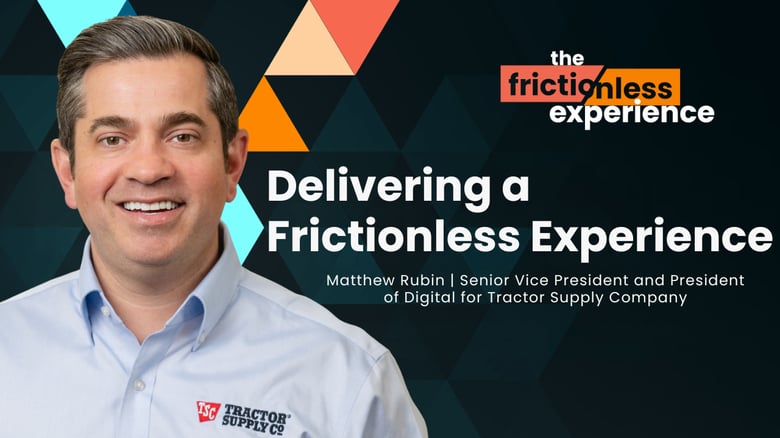
Before becoming SVP and President of Digital and e-Commerce at Tractor Supply Company, Matthew spent his career in retail operations, merchant roles, store management, and even on the vendor side selling into major retailers. That breadth matters.
Because when you’re responsible for selling everything from dog food to stock tanks to live chickens, and delivering pallets of feed to a 60-acre property, “frictionless” means something very different than shaving 200 milliseconds off a product detail page.
On a new episode of The Frictionless Experience, Matthew said something that perfectly captures his approach:
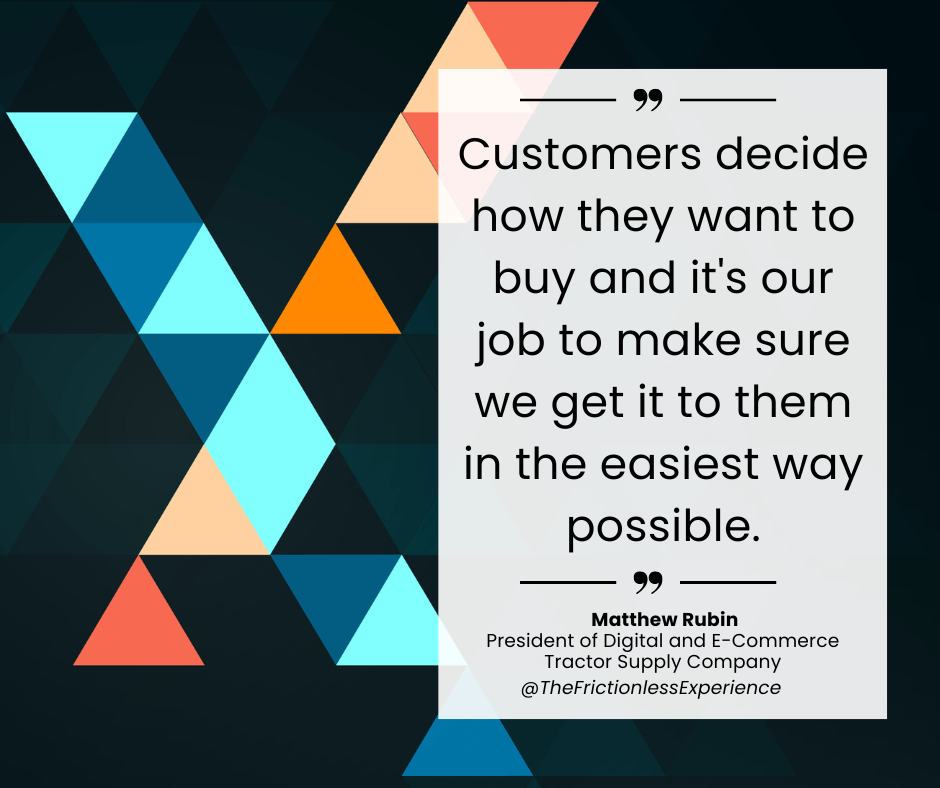
That philosophy is simple. But executing it inside a truly unique environment? That’s where things get interesting.
eCommerce Built for Barns, Not Boardrooms
A lot of brands say they’re “mobile-first.” Tractor Supply is mobile-native. And that distinction isn’t semantic. As Matthew explained:
“We actually design our web experience to be mobile native because most of our customers are out on their properties. They’re walking around their barn or their shed going, ‘Oh, darn. I need XYZ and be able to rapid reorder that product.’”
Think about that context. This isn’t someone on a couch comparing reviews on high-speed Wi-Fi. It’s someone on the far edge of a property, possibly on a weak cell signal, realizing they’re low on feed. They’re not pulling out a laptop. They need to reorder — fast.
Mobile-native means designing for:
- Spotty connections
- One-handed use
- Repeat purchases
- Urgency
It’s about meeting the customer exactly where they are, physically and situationally. As we discussed on the episode, you have to understand where your customer is in order to create a great experience. That’s not just a UX principle. At Tractor Supply, it’s literal.
When “Buy It Again” Deserves Prime Real Estate
One of my favorite examples from the episode is deceptively simple: Tractor Supply elevated “Buy It Again” to a header-level navigation item. Not buried in order history. Not three clicks deep. Right there.
Matthew explained why:
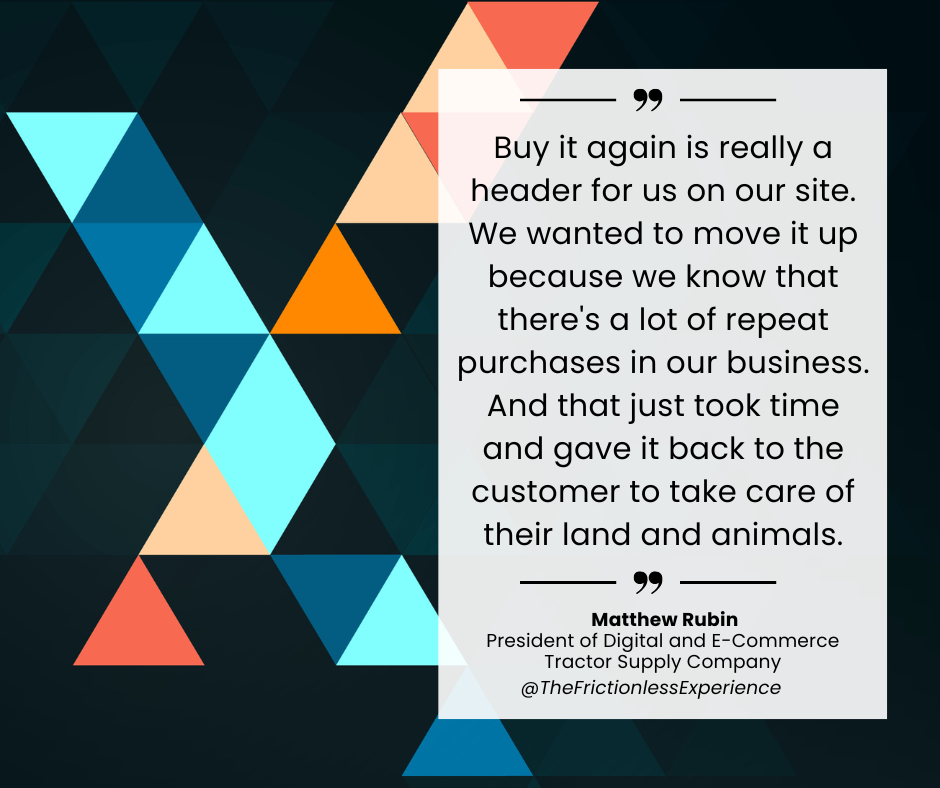
And then he added:
“It's only a couple of seconds, but it made it that much easier. Well, which one did I buy last time? It's right there. You don't have to second guess.”
Two clicks. That’s the difference between momentum and frustration.
In many industries, repeat purchase is an afterthought. At Tractor Supply, it’s core behavior. Customers aren’t browsing for inspiration. They’re reordering feed, shavings, supplements, pet food — often multiple types at once.
When you’re juggling chores and animals, seconds matter. Even Amazon makes reordering a three-step process. Tractor Supply got it to two.
Friction Doesn’t Stop at the Screen
When we asked Matthew what people get wrong about frictionless digital experiences, his answer was sharp and important.
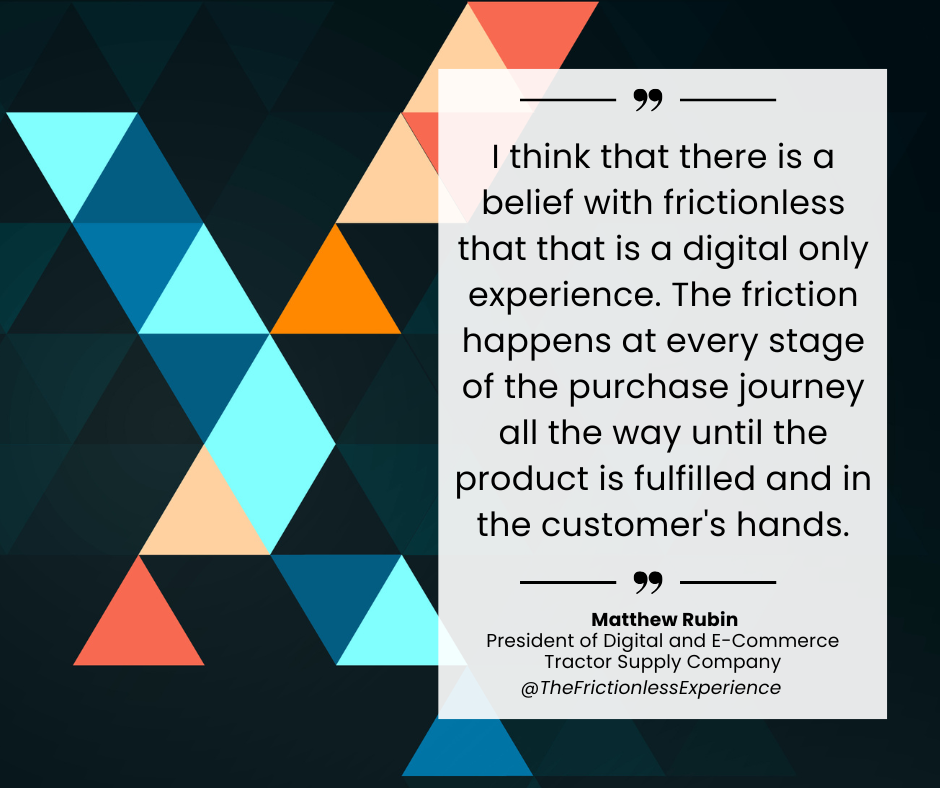
That’s the reframe. If a customer checks inventory online before driving miles into town, the product better be there when they arrive. If they order pallets of feed for delivery, the driver better know where to put them.
Matthew put it plainly:
“If their shopping occasion began online before they walked into the store because they wanted to make sure we were in stock, we better be in stock when they come to pick it up.”
Friction can show up in:
- Inventory accuracy
- Post-purchase communication
- Fulfillment timing
- Delivery placement
Digital leaders who think friction ends at checkout are missing the point.
The Final Mile Is Personal — Literally
Let’s talk about what might be the most unique part of Tractor Supply’s model: last mile delivery.
When you’re shipping apparel, the worst-case scenario is usually a wrinkled box. When you’re delivering 2,000 pounds of feed, the stakes are different.
Matthew described the nuance:
“We're dropping off pallets. Where do you want that to go? How do we take notes for the next driver to know that you don't want that person to just drive it at the end of the driveway.”
And then:
“That is very unique and it's that sort of neighbor type feel that we can do and that is very special. It increases our differentiation to our customers.”
Drivers take notes. They ask questions. They hand-stack pallets into feed barns when necessary. This isn’t just logistics. It’s experience design beyond the interface. If the pallet gets dropped at the wrong end of a long driveway, that’s friction. Real friction. Physical friction. And that’s the point: friction is contextual.
Adapting to a Self-Sufficiency Movement
COVID accelerated a shift toward self-reliance: gardens, chickens, rural moves, dehydrated food, raised beds. Matthew described how customers leaned in:
“One of the side impacts of that was a lot of customers looking to be more self-sustained in their life and lifestyle, people that were just looking for that self-reliance and lifestyle.”
And Tractor Supply adapted. They met demand for flock setups, garden supplies, shelf-stable food, and starter solutions.
Matthew even shared a personal example:
“We make guacamole every single Tuesday in season using all the ingredients from our garden mixed in with avocados. We buy every single thing we need for that at Tractor Supply.”
This is what adaptation looks like in a unique environment:
- Recognizing a cultural shift
- Expanding assortment digitally (10x SKUs vs. store)
- Supporting education for first-time customers
- Meeting both rural core customers and suburban newcomers
It’s not just about adding products. It’s about enabling a lifestyle.
Designing for Education, Not Just Transactions
When new customers adopt a more self-sufficient lifestyle, they have questions. Lots of them.
Tractor Supply launched Scout, an AI-powered experience designed to answer “How do I?” questions in context:
“We like to think of answering that question ‘how do I’. I live in Tennessee, how do I have a raised garden? When should I plant? What do I do at the first frost?”
That’s search plus guidance. It’s replicating the in-store experience where team members often live the lifestyle themselves, but in a digital format. Again, adaptation isn’t about shiny tech. It’s about preserving what works and extending it across channels.
Three Lessons for Digital Leaders in Unique Environments
If you operate in a non-traditional eCommerce category — bulky, rural, operationally complex — here’s what Tractor Supply Company demonstrates:
1. Design for Actual Context, Not Ideal Conditions: Mobile-native means building for barns, job sites, and weak cell signals, not just responsive layouts.
2. Elevate Repeat Behavior to Primary Navigation: If your customers reorder constantly, make that the starting point. Save seconds. Preserve momentum.
3. Treat Fulfillment as Part of UX: From inventory accuracy to delivery placement, friction lives everywhere. Optimize the full journey.
The biggest takeaway from our conversation?
Frictionless isn’t a digital metric. It’s an end-to-end promise.
And in a world where customers might be ordering from a pasture, expecting same-day delivery from a nearby store, and asking where exactly on their property a pallet should land, you don’t get to define what friction means.
They do. And as Matthew said, your job is to make it easy.
Listen to the full episode of The Frictionless Experience for more tips and strategies.


.png)