.svg)
If you've ordered coffee on your phone this week, you've experienced the flywheel that changed QSR forever. Order ahead. Skip the line. Earn points. Get a personalized suggestion. Repeat.
That's the Starbucks playbook, and over the past decade it's become the closest thing the restaurant industry has to a universal template. Nick Paladino and I recently sat down with Rob Tedesco — who spent years leading digital at Subway and now runs restaurant experience work at Bounteous, a 4,000-person global agency, across brands like Dutch Bros, Shake Shack, Carl's Jr., Hardee's, Texas Roadhouse, and First Watch — on a new episode of The Frictionless Experience to unpack why that flywheel spread so fast, and why some of the smartest brands in the category are deliberately leaving pieces of it out.
Rob's mantra for every design decision he makes: "They're just trying to buy a cheeseburger." Everything else is friction management.
The Four Pieces of the Flywheel
Rob broke the Starbucks model down to its core value exchange: the customer hands over their data — a phone number, an email, their order history — and in return expects to save time or money. Starbucks built four mechanisms to deliver on that promise, working in synergy: mobile ordering, payment, loyalty, and personalization. Pay through the app, order ahead, earn stars, and get remembered. Save time, save money, skip the line.
It's such a clean loop that it became the default architecture for the entire industry. But Rob's point — and the reason I wanted to have him on The Frictionless Experience — is that not every brand needs all four gears turning at once.
Texas Roadhouse Doesn't Need Your Loyalty Program
The example Rob reached for was Texas Roadhouse, a Bounteous client that sits about as far from Starbucks on the frequency spectrum as you can get. Where Starbucks has customers who show up daily at a low price point, Texas Roadhouse has an average online check closer to $40 and a visitation cadence closer to once every couple of months.
Two pieces of the flywheel still matter there — remembering a customer's order and payment method, and merchandising adjacent items — but loyalty, Rob told us, just isn't a priority:
"Texas Roadhouse doesn't really have loyalty front and center in its experience. You're not earning sheriff's badges or cowboy hats... and frankly, I don't think they need it because they have such a vibrant... core value proposition of delivering great value, great hospitality, and great quality."
Their digital energy instead goes into wait lists and order-ahead, because demand at peak hours is already through the roof. The lesson: build for your brand's actual frequency, not Starbucks' frequency. Copying the whole playbook when your customer relationship doesn't call for it just adds cost and clutter.
Robots Never Forget the Fries
One of the more counterintuitive things Rob said stuck with both me and my co-host Nick. Ask a human cashier to upsell all day, every day, and eventually they'll forget. Ask an app, and it never will.
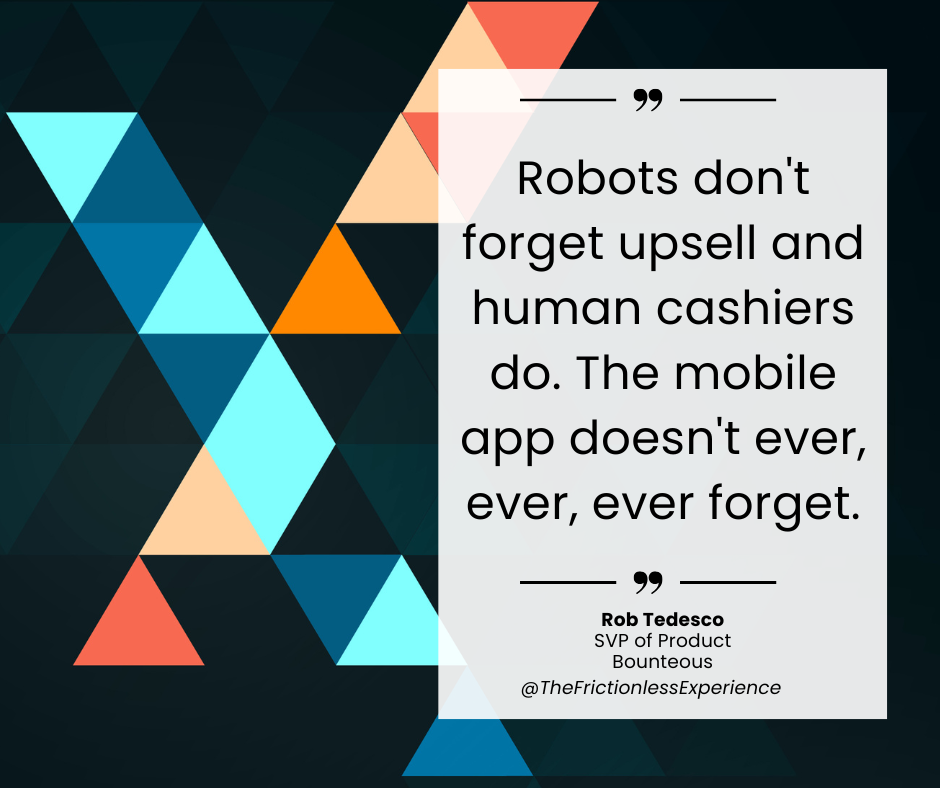
Rob's argument is that this shows up directly in average check size — digital orders tend to run higher than counter orders, in part because algorithmic personalization catches the cross-sell a distracted employee misses.
It's not that the human touch is worthless (Nick made a fair counterpoint that a cashier reading the room and not pushing a sale is its own kind of good service). It's that the two channels are optimized for different things, and brands building a business case for digital investment should be looking at customer lifetime value and average digital check size, not just adoption numbers.
There's a second layer to this that Rob pointed out almost as an aside: delivery checks tend to run higher than takeout checks for the exact same customer, because there's less social friction, or less "shame," as he put it, in ordering a large amount of food when you're not the one carrying it to the counter.
Take the human interaction out of the loop entirely, and people order more freely. It's a strange little wrinkle of psychology, but it's exactly the kind of detail that shapes how these apps get designed.
How Dutch Bros Turned a Paper Punch Card into a #1 App
My favorite part of the conversation was Dutch Bros, the drive-through coffee brand every teenager seems to be obsessed with. My own daughter went through a phase where the first of the month was a mandatory pilgrimage, because Dutch Bros drops a limited-edition sticker you can only get that day.
When the pandemic made their old paper punch-card loyalty program untenable overnight, Bounteous helped Dutch Bros rebuild it digitally. And the smart move wasn't just digitizing the punch card, it was translating the brand's personality into the mechanic.
Rob described the approach: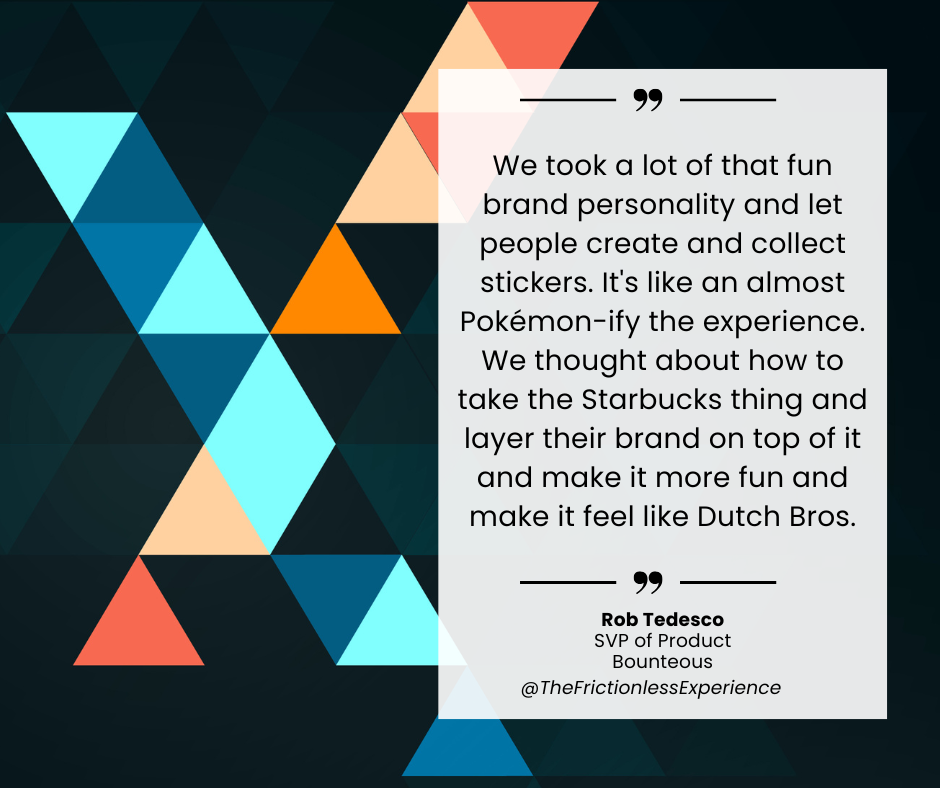 The app hit #1 in the App Store. Same underlying flywheel mechanics as Starbucks — order ahead, scan, earn points — but wrapped in a collectible-sticker layer that made the loyalty program feel like the brand instead of a bolt-on utility.
That's the real takeaway: the flywheel is a structure, not a script. The brands that win make it feel native to them.
Passwordless is Having its Moment, for a Very Human Reason
If there's one piece of friction every restaurant brand is racing to eliminate right now, it's the password. Rob told us it's currently the number one feature request across roughly six or seven of Bounteous's restaurant clients simultaneously.
The winning approach isn't the flashiest one. It's the one people already know:
"What has become the consumer norm? What is the consumer habit that the average person got trained into? ... I think six digit numeric one-time passcodes are secure, easy to remember, and whoever wants to remember a password ever again."
Magic links, Rob pointed out, are functionally the same mechanism — a one-time passcode delivered through a URL instead of typed manually. Device fingerprinting is more exotic, but raises its own problem: if the device itself is the credential, you likely need a second factor (something you know, paired with something you have) to keep it secure.
That security conversation isn't academic for this industry. Restaurant apps, Rob explained, are a persistent target for credential stuffing and DDoS attacks, partly because gift cards make a juicy target. Bounteous, as he put it, ends up functioning as part of the frontline defense for its restaurant clients, which is exactly why passwordless login has jumped to the top of so many roadmaps at once.
The Subway Story that Says it All
Rob told a story on himself that I think is the best illustration of frictional tolerance in this entire episode. Years after leaving Subway, where he'd led the digital transformation, he found himself hungry on the side of a highway with Subway as his only option. He decided to give the app another shot. It had been deleted from his phone. He had to wait for it to re-download, standing in line, trying to remember his old password.
He gave up and just ordered at the counter.
If Rob, the former head of digital at Subway, doesn't have the patience to power through his own app's friction, nobody does. That's the bar every one of these brands is actually building against — not perfection, just don't lose the person who's already standing in your parking lot.
Why QSR Out-Apps Every Other retail Category
Nick asked Rob a question I'd been wondering myself: why has QSR proliferated more mobile apps than almost any other retail category? Rob's answer came down to one word: frequency.
"If you're going to do something a lot, it makes it worth having mobile apps."
He used McDonald's as the clearest case. The average McDonald's app user, in his experience, isn't opening it for the experience. Instead, they're opening it because they're deal-hunting. That deal-driven behavior creates exactly the kind of high-frequency engagement loop that justifies the cost of building and maintaining an app in the first place. Contrast that with categories where you might buy something once a quarter, and the math on app investment gets a lot harder to justify.
That frequency argument also explains why the human side of upselling isn't going away entirely, even as algorithms take over more of it.
I'll offer my own small case study: I pulled through a Chick-fil-A drive-through recently for nothing more than an iced tea for my daughter. The employee asked if we wanted a dessert or fries with that. It's an odd question for a drink-only order, on paper. But I like their brownies, and in the moment, a person asking the right question at the right time turned a simple drink order into an upsell an algorithm might never have surfaced, since no app would have thought to suggest a brownie on a tea-only cart.
Sometimes the human read wins. Most of the time, though, Rob's right: the app just doesn't forget to ask.
The Real Lesson
Every brand wants the Starbucks flywheel. Very few actually need all four wheels turning. The brands getting this right — Dutch Bros leaning into personality, Texas Roadhouse skipping loyalty for wait lists and hospitality, Bounteous's clients racing toward passwordless login — are the ones asking what their customer actually needs, not what Starbucks built.
Want the full conversation? Rob goes deeper on AI-powered ordering, the psychology of privacy trade-offs, and why he thinks people overvalue privacy more than the data suggests they should.
Listen to the full episode of The Frictionless Experience with Rob Tedesco wherever you get your podcasts.