.svg)

The gap between 12 visitors and 12 million is not just a startup problem. It shows up inside large enterprises too, just with different language and bigger budgets.
In a recent episode of The Frictionless Experience, “12 Visitors vs 12 Million: What Most Startups Get Wrong,” Justin Abrams and Mike Rispoli, co-founders of Cause of a Kind, unpack why teams default to scale-stage thinking far too early.
Early-stage founders A/B test with almost no traffic, rebuild products before real usage, or measure themselves against Apple. Enterprise teams do the same in quieter ways. They design for edge cases before validating the core journey, over-engineer workflows to satisfy internal stakeholders, and roll out “global” solutions before a single team has proven they work.
Different environment, same mistake. And they all point to the same underlying issue: founders falling in love with their solution instead of committing to the problem.
There's a cleaner, harder way to build.
As Mike Rispoli, puts it: "The founders that we see are most successful marry the problem but they date the solution."
That idea sits at the center of product-market fit, iterative development, and why most early-stage products stall before they ever get real traction.
The Core Mistake: Falling in Love With the Wrong Thing
Early-stage founders rarely struggle with effort. They struggle with attachment to a specific UX, a feature set, a visual standard, or a grand product vision that hasn't been validated.
The problem is that none of those things are the business. The problem is.
When founders lock into a solution too early, they stop seeing clearly. They start protecting decisions instead of testing them. Rispoli describes how this shows up in practice:
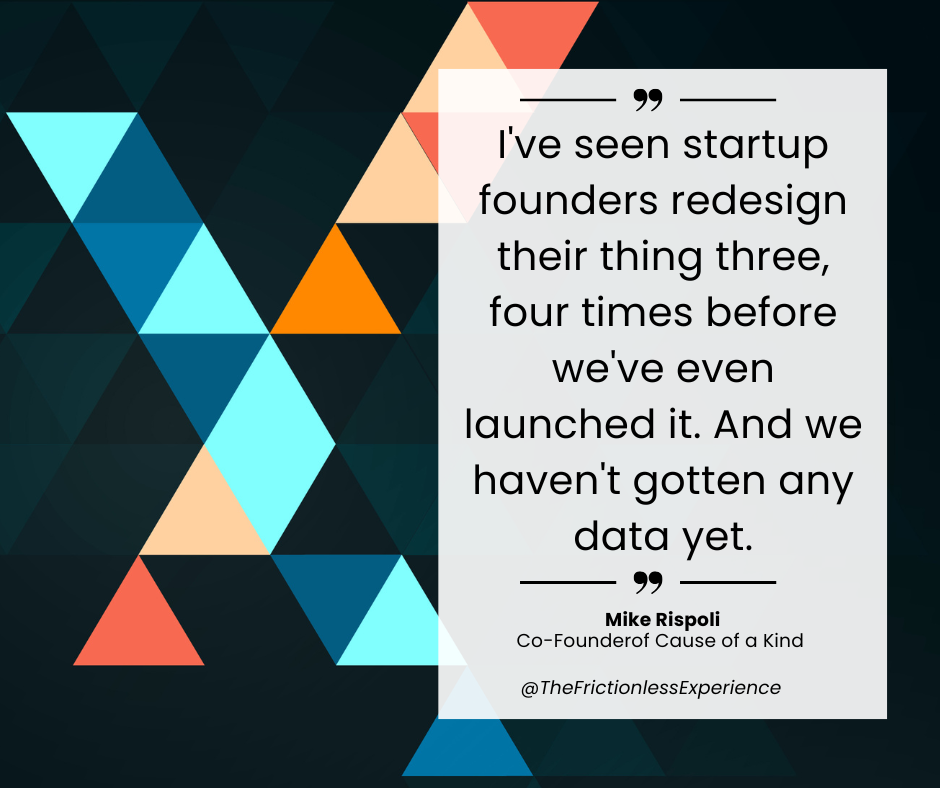
That's not iteration. That's avoidance.
What "Marry the Problem" Actually Means
Committing to the problem means staying anchored to a specific user pain, a clear use case, a real-world need that exists independent of your product. You don't waver on what you're solving. Everything else is negotiable.
That's why the best founders are willing to discard entire implementations when they aren't working. Not tweak them. Not rationalize them. Replace them.
Because the goal isn't to prove the solution was right. The goal is to find one that works.
This is where many founders get it backward. They treat the product as the asset. In reality, the insight is the asset. The product is just the current expression of it.
"Date the Solution": Built-In Permission to Change
Dating the solution creates a different operating posture — one that assumes your first version will be wrong, your second might also be wrong, and that progress comes from replacing, not polishing.
That flexibility shows up directly in how strong founders approach product design. Rispoli again: "At any given time, they're willing to trash what we've done to kind of keep solving that problem as opposed to getting hung up on what they think UX means."
Weak attachment looks like defending design decisions without user data, over-investing in UI before functionality is proven, resisting change because of sunk cost. Strong attachment looks like rapidly replacing flows that don't work, simplifying aggressively, treating every version as temporary.
Product-Market Fit Is a Replacement Process
There's a tendency to think of product-market fit as something you optimize into. In reality, it's something you iterate into. And iteration, at its core, is replacement.
Justin Abrams reframes this through a different lens: "We fail fast, figure out if an idea has validation, deploy as little cash, as little time and as little emotion as you can to a thing."
Then he sharpens it further: "I also love waging war on the word fail. It's all just data."
That mindset matters because it removes the emotional weight from throwing things away. If every iteration is data collection, then replacing a solution isn't failure — it's progress.
Why Features and Vision Become Traps
The earlier you are, the more dangerous complexity becomes. Every additional feature muddies your value proposition, complicates onboarding, and creates more paths to failure.
Rispoli is blunt about it:
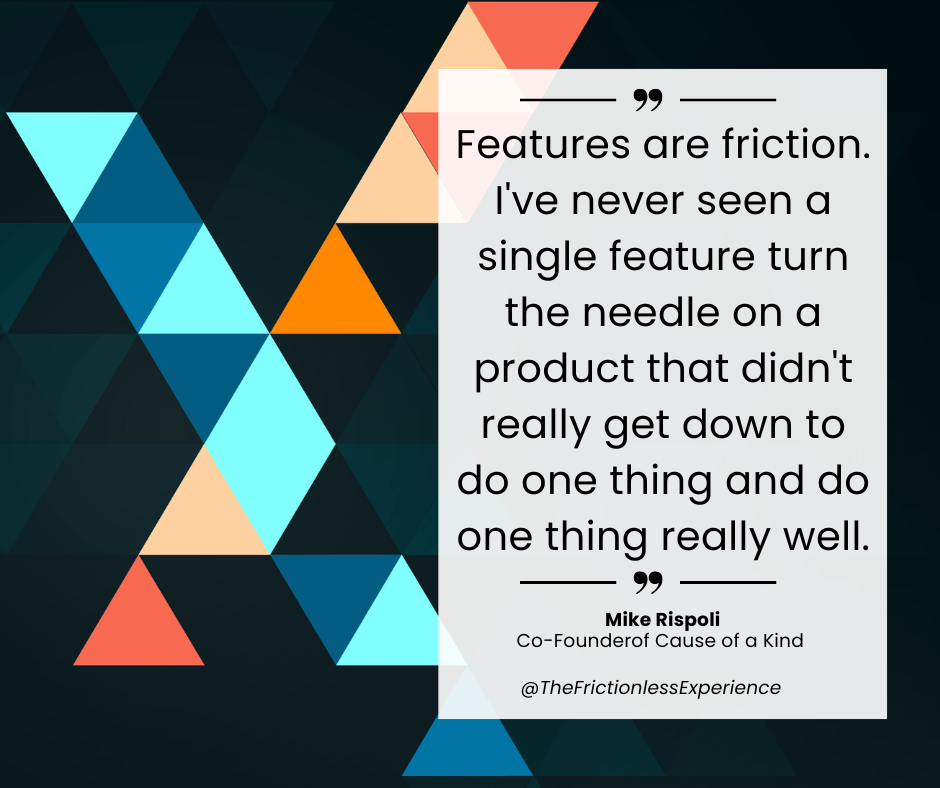
If you're truly committed to the problem, you don't need ten features. You need one that works. Everything else is usually a hedge against uncertainty.
The "Looks Like Apple" Problem
One of the more persistent early-stage traps is aesthetic benchmarking — comparing your product to companies with decades of iteration, massive teams, and enormous data volume, then trying to replicate their output without their inputs.
Rispoli captures the disconnect: "You don't know how many times I've heard, 'You know how Apple does those product things.' It helps to have a trillion dollars in the bank."
The deeper issue isn't ambition. It's sequencing. Polish comes after function. As Rispoli puts it: "The problem should be so big that you got to get the function right first."
Early-Stage Reality: You Don't Have Enough Data for Precision
A lot of founders try to operate like scaled companies too early — running A/B tests, optimizing conversion, tracking granular funnel analytics. But without meaningful traffic, those signals don't exist yet.
Abrams explains the constraint clearly: "If you don't have those numbers, there are certain tried and true ways of building a web experience. Play the greatest hits." Use proven templates, remove unnecessary decisions, focus on getting users to a single outcome. At this stage, the goal isn't optimization. It's validation.
The signal is qualitative before it becomes quantitative. You're asking whether the user understands the product, whether they reach the core action, whether they come back. Rispoli describes how hands-on this actually is: "You're really taking signals at the individual level… you're usually watching them use the thing."
That's not scalable forever. But it's exactly what's required at the beginning.
The First-Dollar Test
Every product has a moment that signals real traction. For some, it's activation. For others, it's revenue. Rispoli frames it this way: "If we can shorten the time to someone's first dollar, they are more likely to stick with us for years."
That's a practical anchor for your iteration. Not "does this feature feel right?" but "does this get the user to the outcome faster?" That's how you stay tied to the problem.
The Discipline Most Founders Avoid
There's a final piece that separates strong founders from everyone else: restraint.
Abrams puts it bluntly: "The discipline to know when something is not going to work." And: "What is the least amount of software that I can build that gets you to your first goal?"
That question cuts through almost every early-stage mistake. Most overbuilding isn't about necessity — it's about discomfort with uncertainty. Adding features, polishing UI, optimizing before you have data: these are ways of feeling productive without facing the harder question of whether the thing actually works.
Founders don't fail because they care too much about their product. They fail because they care about the wrong parts of it — committing to a solution before it's been earned, optimizing before validating, adding instead of removing, polishing instead of replacing.
The alternative is harder but clearer. Stay fixed on the problem. Stay flexible on everything else.
Marry the problem. Date the solution.
