.svg)

I asked Rafael Carranza of PitchBook (and ex-Microsoft and Amazon) on The Frictionless Experience what people get wrong about, well, frictionless experiences.
His answer surprised me.
Most conversations about frictionless digital experiences start in the same place. Speed. Efficiency. Fewer clicks. Better UX. Smarter automation. Maybe a layer of AI to make everything feel instantaneous.
That framing is understandable. It’s also incomplete.
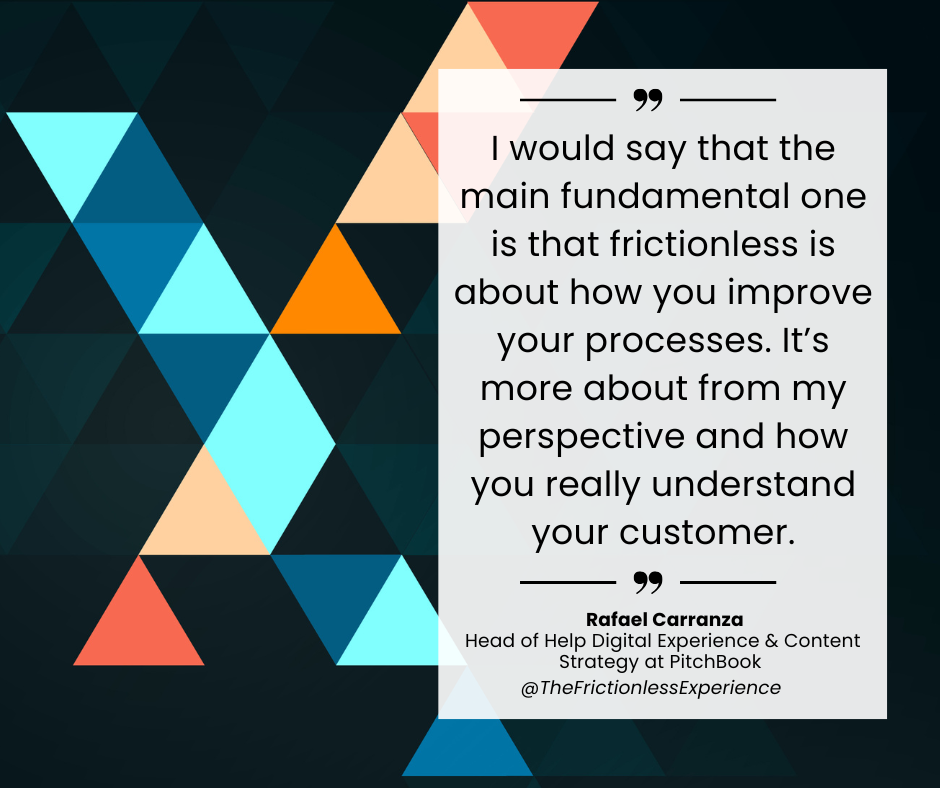
Because what Rafael pointed out—quietly, almost matter-of-factly—is that frictionless experiences don’t begin with technology at all. They begin with understanding. And not the surface-level kind.
That distinction is easy to gloss over. It’s also where most digital product teams get stuck.
They optimize systems without ever fully understanding the human on the other side of them.
The Hidden Assumption Behind Most ‘Frictionless’ Efforts
When teams talk about friction, they usually mean operational friction. Bottlenecks in workflows. Latency in systems. Manual steps that could be automated.
Those things matter. But they’re rarely the root cause.
The deeper friction—the kind users actually feel—comes from misalignment. From the gap between what a company thinks a customer needs and what that customer is actually trying to accomplish in context.
That gap doesn’t show up in dashboards easily. But it shows up everywhere else: hesitation, confusion, workarounds, support tickets, churn.
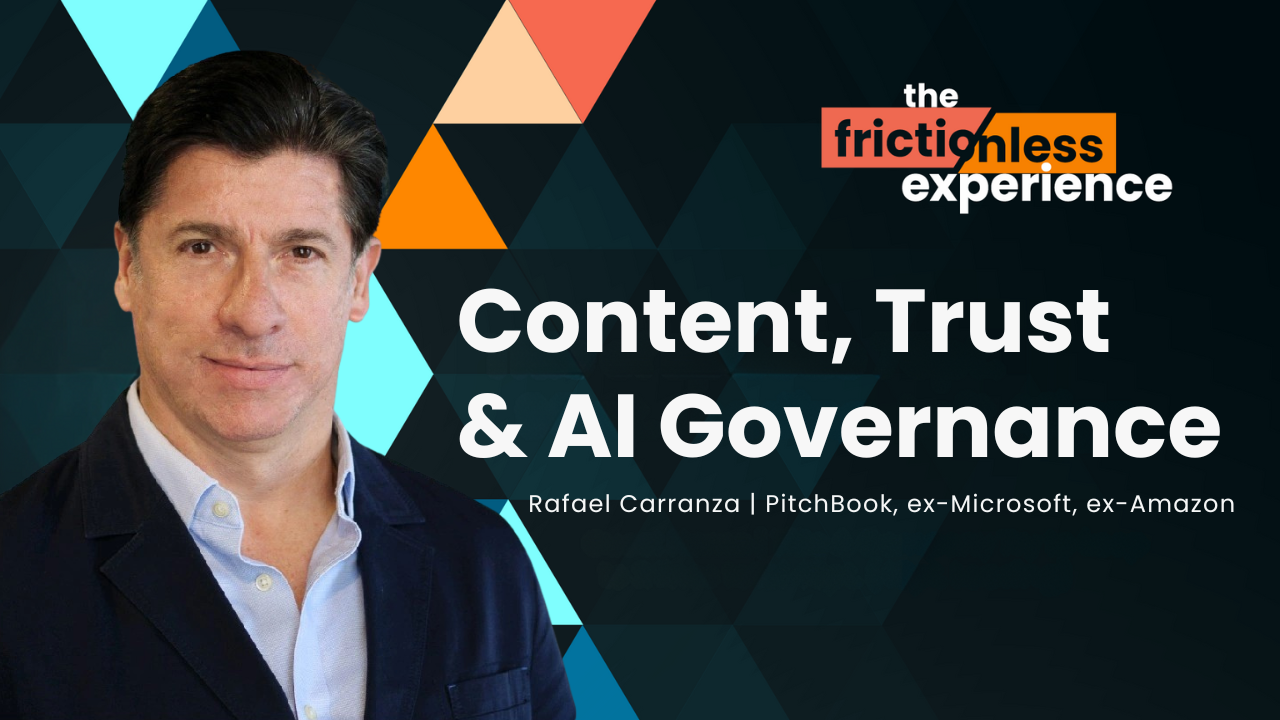
Rafael has seen this dynamic play out repeatedly, across some of the largest platforms in the world.
A Career Built Where Content Becomes Infrastructure
Long before AI was part of the mainstream product conversation, Rafael was working at scale where content wasn’t a nice-to-have—it was infrastructure.
He started during the dot-com boom at EFE, one of the world’s largest wire services.
“From one moment to the other, we have the internet just booming and having thousands of websites wanting to have live content," said Rafael.
The demand wasn’t for better UX. It was for reliable information, delivered accurately, at volume.
Governments depended on it. Publishers depended on it. Platforms depended on it.
And underpinning all of that was trust.
That experience shaped everything that came next—first at Microsoft, helping evolve MSN from a traditional portal into a platform reaching hundreds of millions of users, and later at Amazon, supporting thousands of sellers navigating complex rules, logistics, and policies.
Different contexts. Same lesson.
Friction rarely comes from slow systems. It comes from unclear ones.
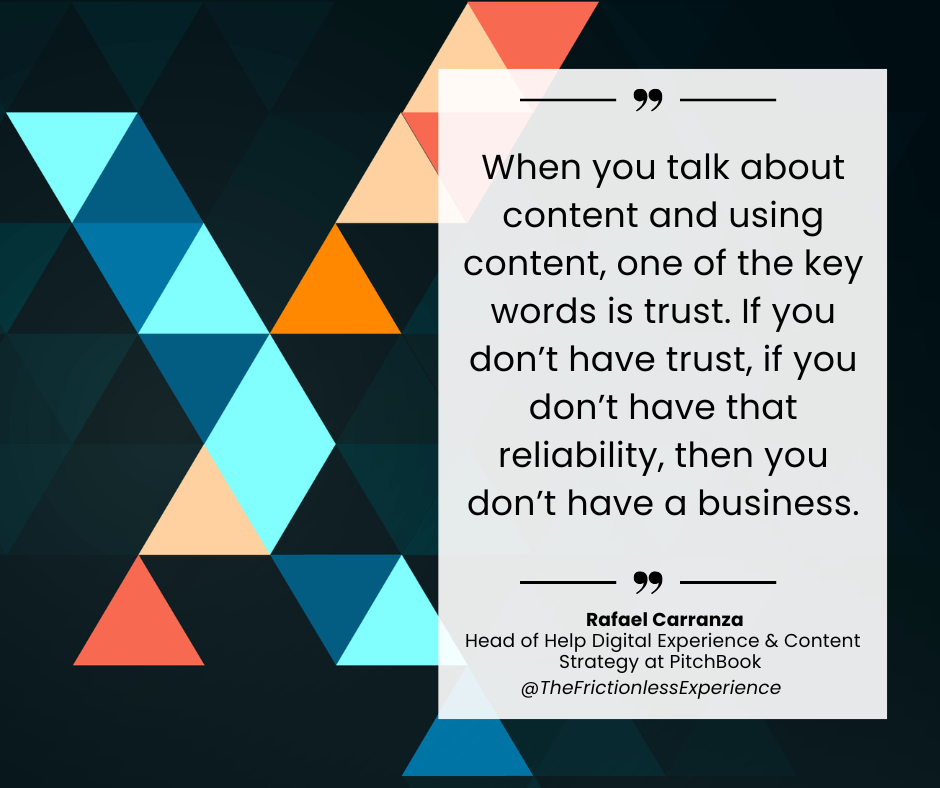
Trust Is the Most Overlooked Source of Friction
We don’t usually label trust as friction. But its absence slows everything down.
Rafael puts it plainly.
When users trust a system, they move forward.
When they don’t, they stop. They double-check. They hesitate. They look for alternatives.
That pause—that cognitive tax—is friction.
At PitchBook today, where Rafael works with data used for high-stakes financial decisions, trust isn’t an abstract value.
“They have built a brand around data and the trust of that data for people that are making very important financial decisions," said Rafael.
In those environments, friction doesn’t just hurt conversion. It creates risk.
AI Raises the Stakes on Friction. It Doesn’t Remove It.
AI has changed the conversation around frictionless experiences, but not in the way most teams expect.
For many organizations, AI is positioned as the shortcut. A way to automate decisions, personalize journeys, and remove effort at scale. And it can do all of those things.
But only if the underlying understanding is already there. Generative AI doesn’t create meaning. It assembles it. Which means any gaps in customer understanding, content clarity, or governance don’t disappear—they get amplified.
This is why hallucinations are rarely just a model problem. They’re a signal that the system doesn’t truly understand its domain or its user.
In a world where AI increasingly sits between customers and decisions, misunderstanding becomes the most expensive form of friction.
When Content Stops Being Marketing
One of the most persistent misconceptions in product organizations is that content is primarily a marketing concern.
Rafael disagrees. He commented: “Content is part of the product, part of the service, and an integral part of your product.” The moment a product requires explanation, rules, or judgment, content becomes part of the interface.
At Amazon, sellers aren’t slowed down by bad design. They’re slowed down by uncertainty.
“There’s a lot of rules that they need to understand. Having the right information at the right time is super important," noted Rafael.
Every unanswered question forces a delay. Every unclear policy introduces friction, even if the underlying system is perfectly engineered.
AI has accelerated this reality.
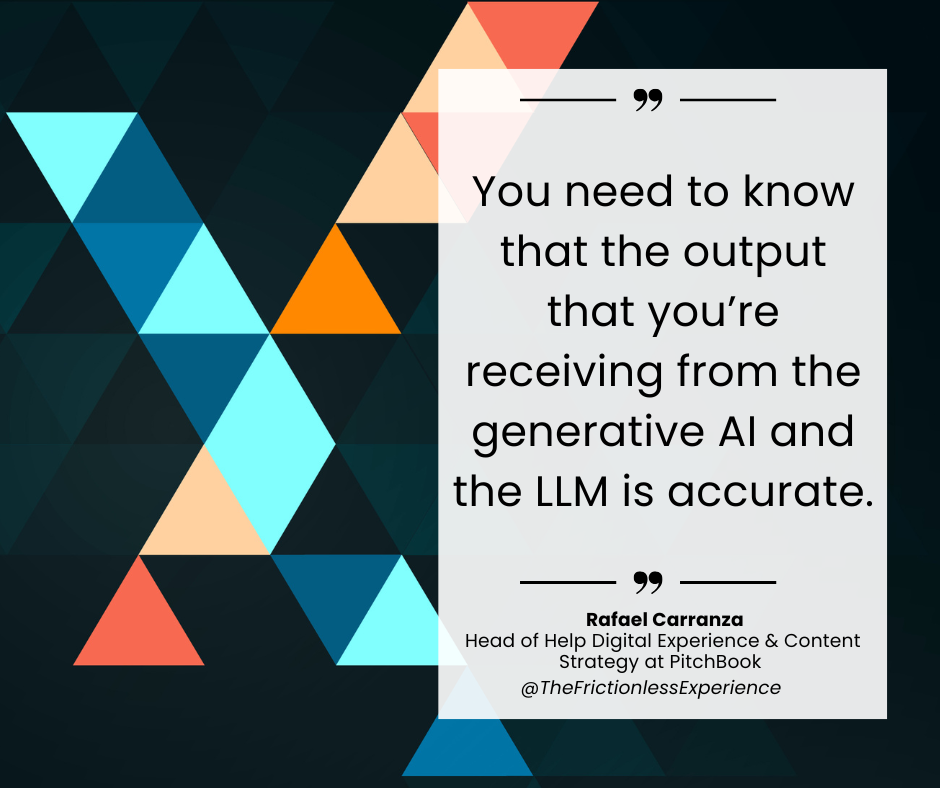
As more teams deploy AI into customer-facing workflows—support, search, onboarding, decisioning—the margin for misunderstanding shrinks. AI systems don’t slow users down when something feels off. They confidently move them in the wrong direction.
That’s why speed without context doesn’t reduce friction. It compounds it.
Generative systems don’t fix misunderstanding. They amplify whatever foundation already exists. When content is inconsistent, outdated, or poorly governed, AI surfaces that chaos faster and at greater scale.
Where Friction Actually Lives
When I asked Rafael what people fundamentally misunderstand about frictionless digital experiences, his answer cut through the noise.
“It’s not about the technology. It’s not about the AI. It’s not about the magic answer on doing things faster," he said.
Instead: “It’s about really, really understanding and taking the time to understand who is on the other side, who you are serving.”
That sounds obvious. Until you realize how rarely organizations truly do it.
They map journeys without context. They optimize funnels without empathy. They automate decisions without understanding intent. And then they wonder why friction persists.
Frictionless Is Contextual, Not Absolute
Frictionless doesn’t mean removing every obstacle. Sometimes friction is protective. For example, Rafael noted: “When you are dealing with huge amounts of requests, introducing some friction helps the process.”
Governance. Quality checks. Intentional pauses.
Those aren’t failures. They’re signals that a system respects the complexity of the user’s decision. So the real question isn’t whether friction exists. It’s whether it’s serving the person on the other side.
When Content Fails, It Fails Loudly
Content tends to disappear when it works. “People don’t think a lot about content until it fails," observed Rafael.
And when it fails at scale, the consequences are real. For instance, he noted: “An email can generate a big situation that could cost millions of dollars.”
Not because of what the email says, but because it didn't reach the right people at the right time.. Miscommunication isn’t a small issue in digital systems. It’s often the most expensive one.
The Real Definition of Frictionless
Frictionless experiences aren’t created by eliminating steps. They’re created by eliminating misunderstanding, and by deeply knowing who the user is, where they are in their journey, and what matters in that moment.
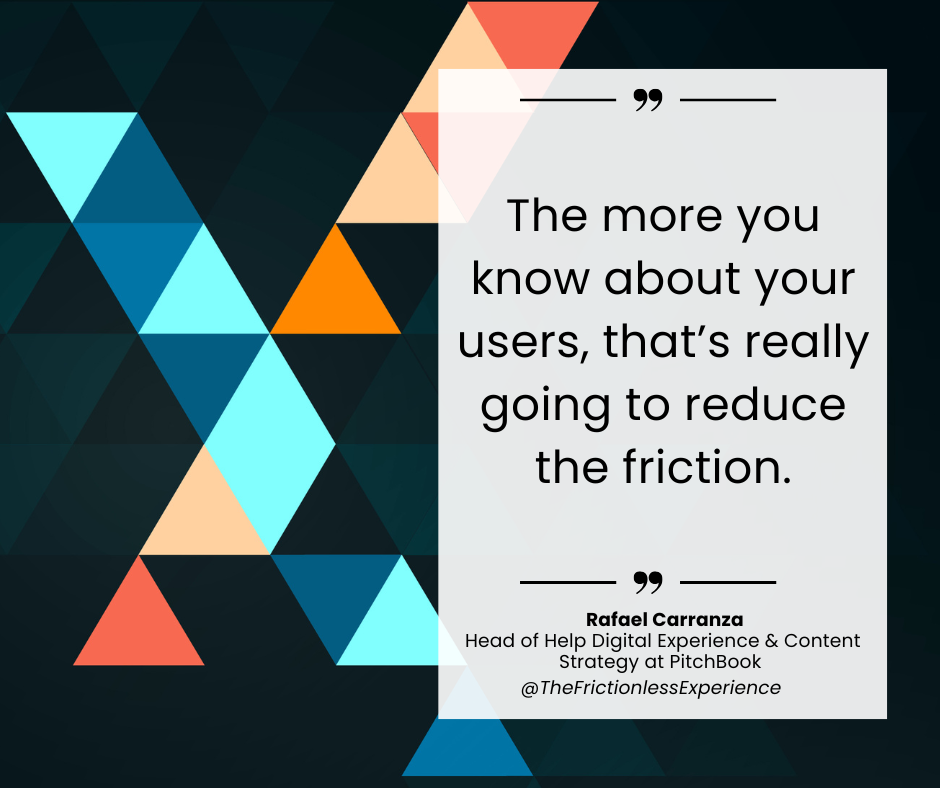
Everything else—UX, automation, AI—is just an amplifier.
Watch the Full Conversation
If this resonates, the full episode of The Frictionless Experience with Rafael Carranza goes much deeper into how content, trust, and AI intersect at massive scale.
Frequently Asked Questions
What is a frictionless digital experience?
A frictionless digital experience minimizes unnecessary effort for the user. It’s not about speed alone—it’s about clarity, relevance, and trust at each stage of the customer journey.
Why do companies struggle to create frictionless experiences?
Many organizations focus on optimizing systems and processes without fully understanding user context. This creates a gap between what the system delivers and what the user actually needs.
How does content contribute to digital friction?
Content creates friction when it’s unclear, outdated, inconsistent, or poorly governed. Clear, trustworthy content reduces hesitation and helps users move forward with confidence.
Does AI make experiences more frictionless?
AI can reduce friction, but only if it’s built on a strong content foundation. Without accurate, well-governed information, AI amplifies confusion rather than eliminating it.
Is all friction bad?
No. Some friction—such as quality checks or intentional pauses—protects users and improves outcomes. The goal isn’t zero friction, but meaningful friction that serves the user.