.svg)

TL;DR: Retail organizations uncovered $6.8 billion in lost revenue last year by quantifying the financial impact of digital friction—the technical issues causing customers to abandon purchases.
Unlike traditional monitoring tools that track uptime and user frustration, revenue assurance platforms identify exactly how much each friction point costs and which fixes deliver the highest ROI.
CFOs at leading retailers are recovering millions by treating digital friction as a P&L issue, not just a technical problem.
Your digital channel is growing. Traffic is up. Marketing spend is working.
But revenue per visitor keeps declining. Conversion rates are flat or falling. And when you ask why, you get technical explanations that don't connect to dollars.
Your IT team reports the site is up 99.9% of the time. Your product team shows you user frustration scores. Your engineering lead wants more budget to "improve performance."
None of them can tell you how much revenue you're actually losing.
Last year retail organizations uncovered $6.8 billion in lost revenue by finally asking the right question: not "is our site working?" but "how much is digital friction costing us?"
The Problem: Your Teams Are Measuring Uptime, Not Revenue
Here's the disconnect happening in most retail organizations:
What technical teams measure:
- Server uptime
- Page load speeds
- User frustration
- Error rates
What finance needs to know:
- Revenue leakage per friction point
- ROI on technical investments
- Cost of doing nothing
- Which fixes recover the most cash
This gap is expensive. Your technical teams know there are issues. They can show you session replays of frustrated users. They can produce charts showing slow page loads.

What they can't do is stack-rank those issues by financial impact or build a business case for fixing them.
Meanwhile, you're left accepting a baseline cart abandonment rate as "normal" when a significant portion might be entirely preventable—and costing you millions.
What Is Digital Friction Costing Your Retail Business?
Digital friction is any technical issue that prevents customers from completing a purchase: slow-loading pages, unresponsive buttons, payment processing delays, pages that freeze during checkout, or forms that don't submit properly.
Research shows that 50% of shoppers abandon their carts if a page takes just two seconds to load1, and 30% of buyers abandon and purchase from a competitor specifically due to slow website speed3. More concerning: 80% of customers who experience slow load times never return to the site.5
But here's what matters to CFOs: these statistics vary dramatically based on your specific pages, customer segments, and business goals. A two-second delay on a product research page has different revenue impact than a two-second delay at checkout. A mobile app friction point affects different customer lifetime values than desktop friction.
You need to quantify your friction costs, not rely on industry averages.
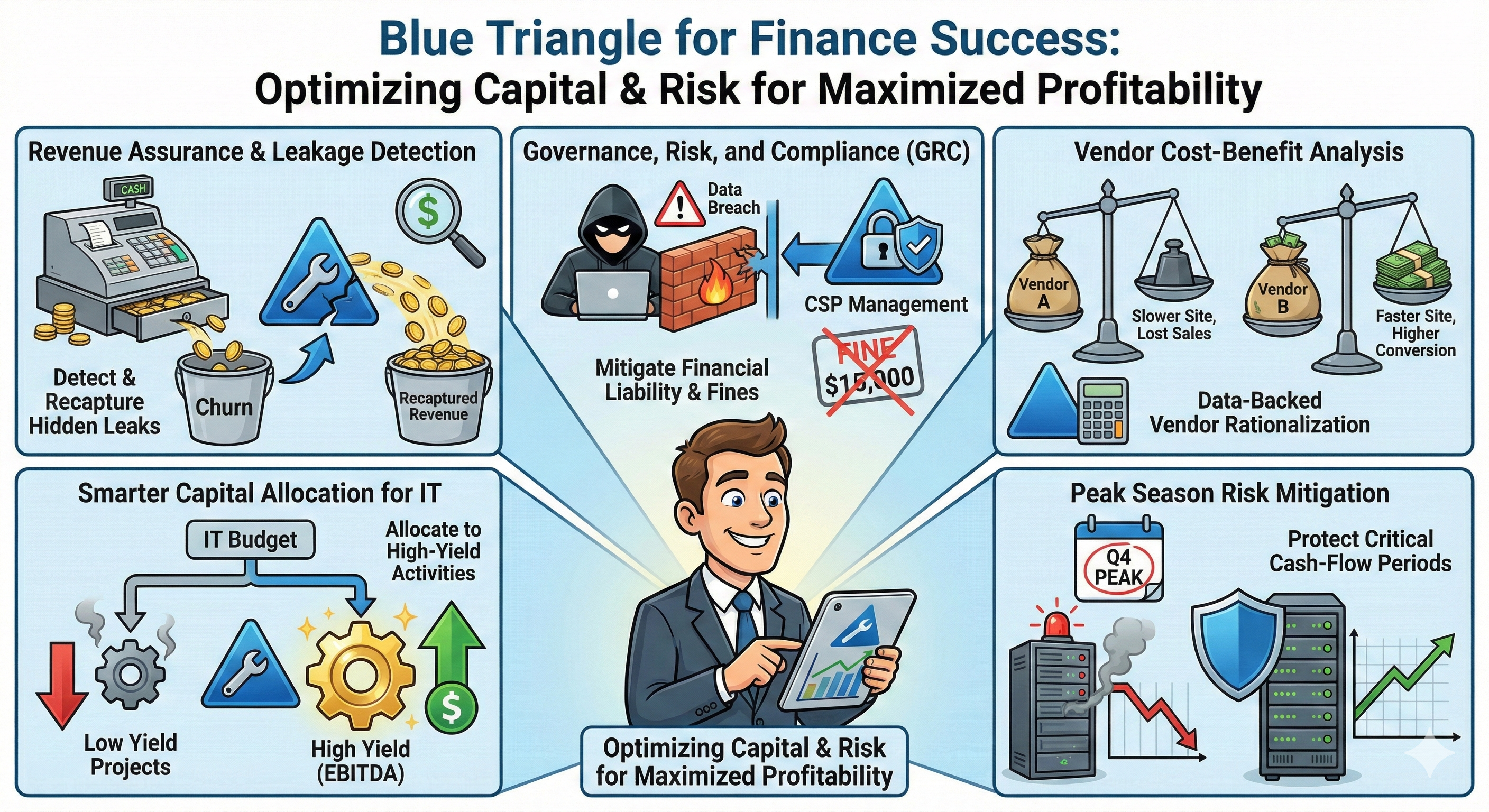
5 Ways CFOs Maximize E-Commerce Revenue by Eliminating Friction
1. How Can You Reduce Cart Abandonment and Recover Lost Revenue?
Industry benchmarks show 70% cart abandonment, so most retailers accept that as inevitable.
But what if 15-20% of that abandonment isn't about price comparison or "just browsing"? What if it's caused by a glitchy checkout button, a payment processing delay, or a page that freezes at the worst possible moment?
The win: When you quantify how much revenue each friction point is costing, cart abandonment stops being a marketing problem and becomes a P&L recovery opportunity. You're not debating whether to fix issues. You're calculating ROI on fixing them.
One retail company recovered over $50M in a single year by identifying and eliminating specific friction points that were silently bleeding revenue. The friction was always there. They just couldn't see the dollar value of fixing it until they measured it.
Key metrics to track:
- Revenue loss per friction point
- Customer lifetime value impact of abandoned carts
- Percentage of preventable vs. inevitable abandonment
- ROI timeline for fixing high-impact issues

2. How Do Third-Party Scripts Impact Your Bottom Line?
Your retail site is likely running dozens of third-party vendors: reviews platforms, chatbots, analytics pixels, personalization engines, ad retargeting tags.
Each one promised to increase conversions. Each one costs you money in licensing fees.
But here's what nobody tells you: many of these vendors are actively decreasing your conversions. Not because their features don't work, but because the performance tax they impose on your site drives customers away before they ever see those features.
The win: When you can measure the revenue impact of every vendor, you transform vendor management from a feature comparison into a financial exercise. That $50K/year reviews platform might be costing you $200K/year in lost sales because of how it impacts the customer experience on your most valuable pages.
Data-backed vendor rationalization lets you cut underperforming tech that hurts margins while simultaneously boosting top-line revenue. It's a rare opportunity to reduce OpEx and increase revenue with the same decision.
Vendor audit framework:
- Measure conversion impact of each third-party script
- Calculate net revenue contribution (value added minus friction cost)
- Identify redundant or negative-ROI vendors
- Optimize placement and loading of necessary vendors
3. How Should CFOs Prioritize Technology Investment for Maximum ROI?
Your engineering team constantly asks for more resources to "reduce technical debt" or "refactor legacy code."
You have no way to evaluate these requests against other priorities. Is refactoring the checkout flow worth more than adding a new feature? Should you optimize the product page or improve search?
The win: When you quantify the revenue impact of technical issues, every engineering request becomes an investment proposal with a projected ROI. "Fixing Issue A will recover $10,000" vs. "Fixing Issue B will recover $1.5M" makes resource allocation obvious.
You can treat IT spend like an investment portfolio, funding projects based on financial return rather than whoever makes the loudest case.
On average, retailers using the Blue Triangle platform see $60 to $80 in revenue recaptured for every $1 spent on eliminating high-impact friction points.
That's not a marketing claim—it's the average ROI from companies measuring actual revenue recovery.
Capital allocation framework:
- Stack-rank technical issues by revenue at risk
- Calculate payback period for each fix
- Measure actual revenue recovery post-implementation
- Build a pipeline of prioritized improvements based on financial impact
4. How Do You Protect Peak Season Revenue (Black Friday, Cyber Monday, Holiday)?
For retailers, Q4 often determines the entire year's profitability. Black Friday, Cyber Monday, and the holiday season are make-or-break moments.
Yet your technical team's definition of "the site is working" (servers are up, no crashes) is very different from your definition (we're capturing projected revenue).
The win: When you monitor performance tied directly to revenue metrics, you get an early warning system for capacity issues before they impact transactions. You're protecting the company's most critical cash-flow period with data that matters to the board: projected revenue at risk.

One bad experience during peak season doesn't just cost you one sale. It costs you the customer. And the lifetime value you've spent marketing dollars to acquire.
Research shows that 46% of online shoppers cite checkout speed as the number one factor determining whether they'll return to a site.2 During peak traffic periods, even minor slowdowns multiply across millions of sessions, turning into eight-figure revenue losses.
Peak season protection checklist:
- Establish revenue-per-minute baselines for key shopping periods
- Set alerts based on revenue impact, not just technical thresholds
- Monitor real-time conversion rates vs. traffic volumes
- Build contingency plans for high-impact friction scenarios
5. What Are the Financial Risks of Poor Third-Party Script Management?
Retailers are prime targets for digital skimming attacks (like Magecart) and data privacy breaches. Often, these vulnerabilities come from unauthorized scripts or poorly managed third-party tags running on your site.
The financial consequences aren't hypothetical. GDPR fines, class-action lawsuits, breach remediation costs, and brand reputation damage can run into tens of millions.
The win: Continuous monitoring of every third-party script running on your site prevents unauthorized access before it becomes a breach. You're not just protecting customer data. You're protecting the company from catastrophic financial liability.
Compliance and risk management:
- Inventory all third-party scripts and their permissions
- Monitor for unauthorized or rogue code execution
- Enforce Content Security Policy (CSP) compliance
- Document vendor security practices for audit purposes
Quantify financial exposure from script vulnerabilities
Revenue Assurance vs. Traditional Monitoring: What's the Difference?
Traditional monitoring tools (APM, observability platforms, session replay) focus on:
- Server uptime and availability
- Technical performance metrics
- User behavior and frustration scores
- Error tracking and debugging
Revenue assurance platforms quantify:
- Dollar value of each friction point
- Revenue recovered by fixing specific issues
- ROI on technical investments
- Stack-ranked priorities by financial impact
The difference? Traditional tools tell you what's happening. Revenue assurance tells you what it's costing.
Ready to see exactly how much revenue your ads are costing you? Get your free Friction Quantified Assessment and discover your hidden millions.
How to Start Quantifying Your Digital Friction Costs
The digital channel represents an increasingly large percentage of your revenue. Yet you're managing it with metrics designed for IT operations, not financial performance.

Your technical teams focus on keeping the lights on. That's important, but it's table stakes.
What you need is visibility into how much revenue friction is costing you—quantified in dollars, not user frustration scores. You need to know which issues bleed the most cash. And you need to stack-rank fixes by financial impact, not technical complexity.
That's the difference between monitoring systems and revenue recapture.
When you can walk into the next board meeting and say, "We identified $8.7M in friction-driven revenue loss and recovered $4.2M in the last quarter," you're not having a conversation about website performance.
You're having a conversation about profit margin improvement.
And that's a conversation every retail CFO should be having.
Frequently Asked Questions
How is revenue assurance different from conversion rate optimization (CRO)?
CRO focuses on testing variations to improve conversion. Revenue assurance identifies and eliminates technical friction that's preventing conversions from happening at all. You're not testing what works better—you're removing what's broken.
Why do companies struggle to create frictionless experiences?
Many organizations focus on optimizing systems and processes without fully understanding user context. This creates a gap between what the system delivers and what the user actually needs.
What's a realistic timeframe for seeing ROI?
Most retailers see measurable revenue recovery within 60-90 days of identifying and fixing their highest-impact friction points, although most Blue Triangle customers start to see impact immediately after deploying fixes.
Do we need to replace our existing monitoring tools?
No. Revenue assurance platforms work alongside your existing stack, but they answer different questions. Your current tools tell you what's happening. Revenue assurance tells you what it costs and what to fix first.
How accurate is the revenue quantification?
The methodology correlates specific friction events with transaction abandonment, measuring actual revenue loss rather than estimating from industry benchmarks. It's based on your data, your customers, and your conversion patterns.
Sources
[1] Baymard Institute and industry research on cart abandonment
[2] Akamai and checkout abandonment research
[3] Industry research on cart abandonment due to performance issues
[5] Mobile commerce and page speed research